

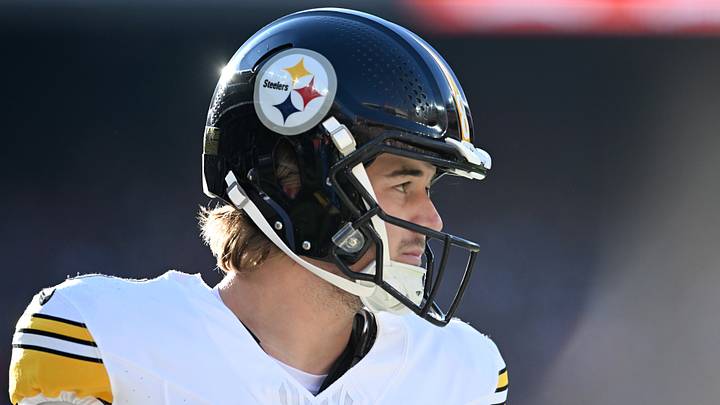
The Pittsburgh Steelers are one of the most successful franchises in NFL history, especially since the AFL/NFL merger back in 1970. Much of that success came in the 1970s, and it's no surprise that they absolutely dominated the NFL draft process during that decade. They drafted a whopping eight Hall of Famers in the '70s, including four in their legendary 1974 draft class that featured Lynn Swann, John Stallworth, Jack Lambert, and Mike Webster.
Still, no teams are perfect when it comes to selecting college prospects. Some picks are simply underwhelming, while others can set franchises back for years. Pittsburgh has seen its fair share of draft busts come and go, but some stand above the rest for just how disappointing they were.
Some were high picks that never developed, while others were notable for just how short their careers with Pittsburgh ended up being. With that being said, here are the 20 biggest draft busts in Steelers history, starting with the most recent draft pick to crack the list.
Ranking the 20 biggest draft bust in Pittsburgh Steelers history
[Disclaimer: There will be players missing from this list that you may expect to see, most notably 1983 first-round pick Gabe Rivera and 2015 second-round pick Senquez Golson. While both are undoubtedly busts, their careers were so heavily impacted by injuries that placing them here felt wrong. I tried to focus on players who at least had the chance to prove whether they were good or not, so that is why you won't see them here.]
20. Broderick Jones, OT (14th overall, 2023)
Depending on how much of the blame for Broderick Jones' failure in Pittsburgh you put on himself or the coaching staff, this ranking will either feel way too low or not fair to him at all. Regardless, the Steelers' most recent first-round mistake makes my list due to his ample opportunities to turn things around.
Jones started all but seven of his 45 career games while in Pittsburgh, but he never seemed to develop beyond being a liability at offensive tackle. Between ugly whiffs in pass protection and his constant flipping back and forth between left and right tackle, he never settled in as the franchise cornerstone fans hoped he would be. Now in Dallas, only time will tell if he can ever make good on the talent that made him a top 15 pick.
19. Chase Claypool, WR (49th overall, 2020)
Chase Claypool's inclusion on this list probably doesn't surprise Steelers fans, but he is a bit of a unique case. His overall production while in Pittsburgh was actually rather impressive for a player taken just inside the top 50, with 2,024 receiving yards and 12 touchdowns in just 39 career games for the Steelers.
Unfortunately for Claypool, his production not only dipped in his final season with the black and gold, but his lack of maturity and overall boneheaded mistakes (we all remember the Vikings game mishap back in 2021) caused him to be traded to the Bears for a second-round pick at the trade deadline midway through his third season. Who did Pittsburgh get with that pick again? Oh, right. Moving on.
18. Walter Abercrombie, RB (12th overall, 1982)
If you are an older Steelers fan who was around when Walter Abercrombie was selected No. 12 overall back in 1982, his placement on this list may surprise you. Abercrombie was a star at Baylor, where he is still second on the school's all-time rushing list. Billed as a potential replacement for the aging Franco Harris, he never quite became the lead back that the Steelers had hoped he would.
Still, his overall production and longevity in the NFL dwarf most of the players in these rankings, so placing him any lower felt wrong. He compiled 4,708 yards from scrimmage and 29 total touchdowns over seven seasons, and even had two seasons with over 1,000 total yards. He was a disappointment, to be sure, but not to the same level as many others on this list.
17. Scott Shields, SAF (59th overall, 1999)
Scott Shields was a massive safety prospect coming out of Weber State in 1999, and I don't say massive lightly. Listed at 6'4" and 228 pounds, the Steelers took him 59th overall in hopes of adding a physical presence to their secondary.
However, Shields was much more of a playmaker than an enforcer on the back end, evidenced by his 23 career interceptions in college and the four passes he picked off during his rookie season. Whether it was a dispute about his playstyle or just a decline in his play, Shields would only last two seasons in Pittsburgh, cementing his place as a draft bust.
16. Will Blackwell, WR (53rd overall, 1997)
Will Blackwell was a highly touted prospect coming out of San Diego State back in 1997. He was coming off consecutive 1,000-yard seasons when he was selected 53rd overall by the Steelers. Unfortunately for Pittsburgh, Blackwell never became a major contributor to the offense.
His career numbers barely add up to a solid season for a No. 2 or No. 3 receiver, with just 67 career receptions for 682 yards and two touchdowns. Blackwell would last just five seasons with Pittsburgh before calling it a career.
15. Ricardo Colclough, CB (38th overall, 2004)
The Steelers' 2004 draft is one of the most consequential in team history, as they selected future Hall of Fame quarterback Ben Roethlisberger No. 11 overall. Unfortunately, their second-round pick at No. 38 didn't exactly have the same impact. Cornerback Ricardo Colclough started zero games in four seasons with the team, and his most notable moment actually came as a return man.
Back in 2006, he muffed a punt late in a game against the Bengals that ultimately led to a touchdown, causing Pittsburgh to lose 28-20. After a brief stint in Kansas City following his time with the Black and Gold, Colclough retired with just one career interception.
14. Alonzo Jackson, LB (59th overall, 2003)
After a long and productive career, the Steelers were looking for a potential replacement for pass rusher Jason Gildon during the 2003 draft. Their choice ended up being Florida State's Alonzo Jackson, who was coming off a 13-sack senior season. Despite being more of a true defensive end in college, Pittsburgh attempted to transition him to a 3-4 outside linebacker role.
After just nine games and eight total tackles, the former 59th overall pick was released prior to the 2005 season. He would play just nine more games for the Eagles and Giants before his career in the NFL came to an end.
13. Jeremy Staat, DE (41st overall, 1998)
The Steelers drafted their first Hall of Famer in a decade when they selected guard Alan Faneca in the first round of the 1998 draft. However, their second pick in that draft ended up being a major dud. Jeremy Staat was a big, powerful defensive lineman who earned All-American honors during his final season at Arizona State, but he was unable to make a successful transition to the NFL.
He started just two games in three seasons with the team, finishing with just 30 total tackles and zero sacks in 29 games. Not exactly what they hoped for when they made him the 41st pick in 1998.
12. Devin Bush Jr., LB (10th overall, 2019)
I know, I know: you think this ranking is far too low. Devin Bush Jr. was a disaster for the Steelers near the end of his time with the team, and the fact that they traded up to pick 10 in the 2019 draft to take him makes it feel even worse. They passed on multiple Pro Bowl players as well, with Chris Lindstrom, Dexter Lawrence, and Jeffrey Simmons all being taken within 10 picks of Bush.
However, similarly to Abercrombie, Bush was at least productive at times for the Steelers. His rookie season was quite good, finishing third in Defensive Rookie of the Year voting. His ACL injury during his second season stunted his development as well, and he never regained his confidence while in Pittsburgh. Over the last two years, however, he has turned into a legit starter for the Browns and Bears. Overall, he wasn't as bad as fans remember, even if he was still a clear bust.
11. Greg Hawthorne, RB/TE/WR (28th overall, 1979)
Greg Hawthorne is one of the more interesting names on this list, mostly due to his journey from being a first-round running back to playing both wide receiver and tight end by the time his career ended. In Pittsburgh, he never developed into an effective runner who could complement Franco Harris.
After five seasons with never more than 226 rushing yards, Hawthorne was asked to move to wide receiver. He ended his career with nearly twice as many receiving yards (1,112) as rushing yards (527). Still, he played nine years in the league and had some amount of production, so he ends up in the middle of these rankings.
10. Limas Sweed, WR (53rd overall, 2008)
Oh, boy. Where to even begin with Limas Sweed? The former Texas standout is the last player on this list who was drafted outside of the first round, and it's for good reason that he still ranks this high. The massive 6'5", 220-pound receiver was expected to become a reliable target for QB Ben Roethlisberger, but injuries and ineffectiveness limited him to just 20 career games and seven receptions for 69 yards.
The lasting memory of Sweed for Steelers fans is an unfortunate one. During the Steelers' AFC Championship battle with the Baltimore Ravens in 2008, Sweed was wide open down the sideline for a touchdown but dropped the pass. While the Steelers would still win and go on to defeat the Arizona Cardinals in the Super Bowl, it was a microcosm of how his career in Pittsburgh ultimately went.
9. Tom Ricketts, OG/OT (24th overall, 1989)
Tom Ricketts wasn't even the worst pick the Steelers made in 1989 (more on that later), but he still certainly deserves to be this high in the rankings. Ricketts starred at the University of Pittsburgh before being selected 24th overall by his hometown team, but he never became a consistent presence on their offensive line.
He started just 13 of the 42 games he appeared in for the Steelers, bouncing between tackle and guard throughout his career. He left Pittsburgh after four seasons and spent time with the Colts and Chiefs before falling out of the league entirely after the 1993 season.
8. Troy Edwards, WR (13th overall, 1999)
From one disappointing wide receiver pick to another, Troy Edwards was supposed to be the Steelers' next great wide receiver. He was absolutely dominant in college, putting up massive numbers for Louisiana Tech over his final two seasons. He holds the FBS record for receiving touchdowns in a season with 27 during his 1998 campaign, and his 140 receptions that same year are still tied for fifth-best all-time.
That insane production led to the Steelers selecting him 13th overall in 1999, and his rookie season showed flashes of the player they were hoping to get. He finished with 61 catches for 714 yards and five touchdowns, but he never came close to reaching those totals again while in Pittsburgh. He was traded to the Rams in 2002 after falling behind Plaxico Burress and future Hall of Famer Hines Ward in the receiver pecking order, cementing himself as a major draft bust.
7. Darryl Sims, DE (20th overall, 1985)
Darryl Sims is one of many instances where college success didn't translate to NFL stardom. Sims was a two-time All-Big Ten selection and one of the best defensive linemen in Wisconsin Badgers history, but he never became a contributor for Pittsburgh after being selected 20th overall in 1985.
He lasted just two years with the Steelers, ending up with just three sacks and one forced fumble. He would then spend two years with the Browns before being out of football entirely. It's fair to say that they have had much more success drafting Wisconsin defenders nowadays (looking at you, T.J. Watt/Nick Herbig/Keeanu Benton).
6. Artie Burns, CB (25th overall, 2016)
When Artie Burns was drafted 25th overall in 2016, Steelers fans were hoping that he would finally be the No. 1 corner they had been lacking for years. Instead, he became a sore spot in the secondary for his entire time with the franchise.
His biggest issue was, ironically, being burned in coverage far too often, and it led to a ton of explosive plays allowed during his tenure. Pro Football Focus credited him with allowing a whopping 15 touchdowns during his four years in Pittsburgh. After leaving the Steelers after the 2019 season, he has bounced around the league and is currently a free agent.
5. Jarvis Jones, EDGE (17th overall, 2013)
Jarvis Jones is likely the first name that younger Steelers fans think of when discussing draft busts, and for good reason. Jones was an elite player at Georgia, earning All-American Honors during his final two seasons in 2011 and 2012, as well as being named SEC Defensive Player of the Year in 2012.
He parlayed that success into being the 17th overall pick by the Steelers in 2013, but it quickly became clear that he would never live up to his draft status. While Jones was incredibly productive at Georgia, racking up 28 sacks over his two seasons as a starter, his lack of size and athleticism kept him from developing into an NFL-caliber pass rusher.
He finished his Steelers' career with just six sacks in 50 games, and he was out of the league after just four seasons.
4. Jamain Stephens, OT (29th overall, 1996)
There are plenty of things I could point to as reasons why Jamain Stephens is one of the biggest draft busts in Steelers history, but two stand above the rest. First, Pittsburgh didn't spend a first-round pick on a tackle for 27 years after they selected Stephens with the 29th overall pick in 1996. Is that because of how poorly he turned out? Maybe, maybe not. Still, it's hard not to think it played a factor.
Then there is the infamous incident at Steelers training camp on July 30th, 1999. Players were performing a set of 14 40-yard dashes that were typical on the first day of camp, but Stephens only managed to run 11 of them before nearly falling over from exhaustion. Bill Cowher was the Steelers' head coach at the time, and the poor display was so bad that he cut Stephens that very night.
Ultimately, Stephens started just 11 games for Pittsburgh before spending three uneventful seasons with the Bengals.
3. Tim Worley, RB (7th overall, 1989)
I mentioned earlier, when discussing Tom Ricketts' disappointing Steelers career, that he wasn't their worst pick in 1989, and that is because of who they selected at No. 7. Tim Worley was supposed to be the Steelers' next great running back, but a combination of injuries, poor play, and a suspension for substance abuse in 1992 led to him being one of the biggest busts in team history.
His rookie season showed some promise, as he led the team with 770 yards on the ground. Unfortunately, he would never eclipse 500 rushing yards again over the rest of his six-year career. Worley lasted just four years and 33 total games in Pittsburgh before spending two unproductive years with the Bears.
2. Kenny Pickett, QB (20th overall, 2022)
Maybe it's recency bias, or maybe it's the importance of the position, but I think Kenny Pickett has a case to be one of the biggest draft busts in Steelers history. Everything about the choice screamed desperation by Pittsburgh. Ben Roethlisberger had just retired that offseason; long-time general manager Kevin Colbert was set ot retire and didn't want to leave without finding a new QB, and Pickett was the local kid coming off a huge final season for Pitt.
Instead of simply rolling with veteran Mitchell Trubisky or taking a different QB later in the draft, Pittsburgh forced the selection of Pickett at No. 20 overall, and we all know how it turned out. After just 24 starts and only 13 passing touchdowns to his name, the Steelers were quick to move on. He has since bounced around to a whopping four different teams, and he has looked worse and worse with each opportunity he has gotten to see the field.
1. Huey Richardson, LB (15th overall, 1991)
Despite all of the obvious draft busts that have been mentioned in these rankings, there was no doubt who would be No. 1 on this list. The Steelers selected Huey Richardson 15th overall in 1991 out of Florida, but it quickly became clear that they made a massive mistake. He played in just five games as a rookie before being traded to Washington before his second season.
Not all of the blame falls on Richardson for his struggles, however. He made a name for himself as a pass rusher while in college, but the Steelers HC Chuck Knoll moved him to inside linebacker due to his lack of size to play in their 3-4 scheme. When Bill Cowher took over for Knoll the following season, he tried to move Richardson back into a pass-rushing role, but he didn't show much during camp.
Perhaps the biggest indictment of any player on this list came from Cowher, who asked director of football development Tom Donahue if cutting Richardson was an option just weeks into camp in 1992. While he was ultimately traded, as I mentioned previously, the fact that cutting him after just five games was on the table tells you everything you need to know about how his career turned out.
 Add us as a preferred source on Google