

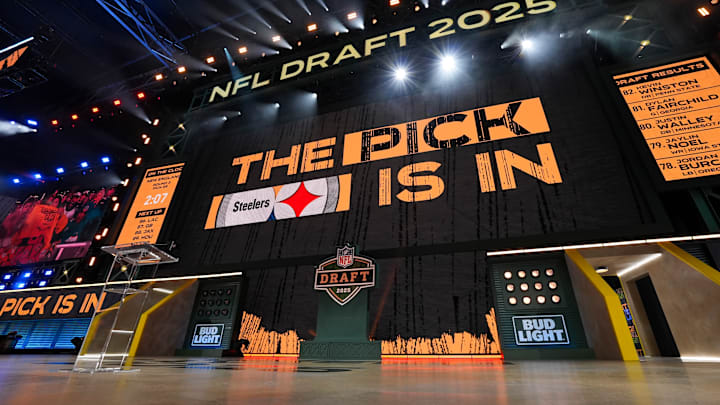
While the Pittsburgh Steelers fight for an AFC North title, many fans are already thinking about April and how GM Omar Khan can build the roster.
And while Aaron Rodgers attempts to turn back the clock and lead the Steelers to the playoffs, questions remain about the next steps and next roster additions to keep Mike Tomlin's group competitive.
While much will change before we get to April, with scheme fit, personal evaluation, and conversations with scouts across football in mine, here is an early look at where the Steelers could go come April.
Pittsburgh Steelers' 7-round Mock Draft attempts to solve WR and QB problem
Round 1 (No. 20 overall): Makai Lemon, WR, USC
Lemon brings a dynamic skill set that immediately elevates the ceiling of Pittsburgh’s passing game, offering explosive acceleration, instant separation, and a level of route nuance uncommon for a receiver his size. Despite his lack of verticality, he consistently plays bigger than his frame, wins through contact, and operates with the polish of a high-volume, scheme-versatile weapon who can thrive with whichever quarterback ultimately leads the offense moving forward.
Round 2 (No. 52 overall): LaNorris Sellers, QB, South Carolina
Selecting Sellers here reflects more of the evaluation of his current tape than an attempt to predict the trajectory of draft-day demand, as his ceiling is unquestionably high enough for a first-round bid if he declares and a team falls in love with his unique physical profile.
The dual-threat traits are exceptional -- elite arm strength, dangerous mobility, and flashes of high-level, tight-window placement -- but the week-to-week consistency still has room to grow as he continues to refine his mechanics and decision-making in the SEC.
Pittsburgh, in this scenario, provides an optimal environment -- an ascending receiver in Lemon, a proven playmaker in DK Metcalf, capable tight ends, competent backs, and a stabilizing offensive line -- giving Sellers a structure conducive to long-term development. He carries a firm second-round grade on current film, with the type of upside that makes this a calculated, high-reward swing.
Round 3 (No. 84 overall): D'Angelo Ponds, CB, Indiana
Ponds offers positional flexibility and competitive toughness that fit seamlessly into a defensive backfield seeking depth and matchup-specific versatility. Though undersized, he plays with fearless urgency, triggering downhill, competing at the catch point, and showing the fluidity to survive both in the slot and on the perimeter.
His athletic profile and temperament also make him an immediate contributor on special teams, giving Pittsburgh a plug-and-play depth option with developmental upside across multiple secondary roles.
Round 3 (No. 98 overall): Isaiah World, OT, Oregon
World’s transfer from Nevada to Oregon showcased a significant leap in both competition level and technique refinement, positioning him as one of the more pro-ready tackles in the class. His play strength, length, and functional movement skills suggest he can compete early for reps at left tackle-- a position currently unsettled in Pittsburgh -- and he fits well into a young offensive line core already built around Troy Fautanu, Zach Frazier, and Broderick Jones.
His upside as a long-term bookend and his readiness to handle NFL speed make him a strong value here. In 335 pass pro snaps this fall, World has allowed just one sack. Keep an eye on him as Oregon enters the CFP.
Round 4 (No. 120 overall): Skyler Bell, WR, UConn
Bell enters the cycle as one of the more undervalued Group of Five wideouts, combining reliable hands, physical route running, and a competitive demeanor that has translated into consistent production. His Senior Bowl appearance will be critical in evals, providing the chance to validate his skill set against top-tier corners, as a strong week could push him well beyond this draft slot.
As currently projected, he offers Pittsburgh a sturdy, dependable complementary receiver who can work through contact, win underneath, and provide rotational value across multiple alignments.
Round 4 (No. 133 overall): Boubacar Traore, EDGE, Notre Dame
Traore brings a raw but highly intriguing athletic profile, offering the burst, length, and natural leverage to develop into a situational pass-rush piece on Day 3. His game is built on traits -- first-step quickness, flexibility, and flashes of power -- and with NFL coaching, he can evolve into a consistent third-down disruptor.
For Pittsburgh, he represents a developmental lottery ticket who fits the long-term mold of their edge rotation.
Round 5 (No. 159 overall): Trey Moore, ED/LB, Texas
Moore’s hybrid skill set makes him one of the more versatile defensive prospects available on Day 3, capable of functioning as a stand-up rusher, an overhang linebacker, or a rotational pressure piece in a multiple-front structure. His athleticism, range, and production at UTSA before transferring to Texas highlight a player with meaningful upside, and Pittsburgh can deploy him creatively while allowing him to grow into a defined role within the front seven.
Round 5 (No. 176 overall): Earnest Greene III, OL, Georgia
Greene offers positional flexibility with the strength and technical baseline to play both guard and tackle, projecting comfortably as a sixth offensive lineman with the upside to step into starting-caliber snaps if developed properly.
Round 6 (No. 198 overall): Demonte Capehart, iDL, Clemson
Capehart entered college with significant buzz and has drawn consistent attention from scouts due to his frame, explosiveness, and interior disruption potential, though off-field issues and inconsistent opportunity have reduced his stock.
With Clemson’s spotlight shifting to other defenders like Peter Woods, Aveion Terrell, and AJ Parker (all projected Top 50 picks), Capehart becomes a value play on Day 3 -- a developmental interior presence with the size and tools worth investing in. In Pittsburgh, he would benefit immensely from learning behind veterans such as Cameron Heyward, T.J. Watt, and Nick Herbig, while receiving support from young linemen like Keeanu Benton, who understand the demands of multiple interior alignments.
Round 6 (No. 211 overall): Bud Clark, SAF, TCU
Clark is a long-tenured college defender known for his physicality, downhill trigger, and ability to function as an enforcer in the middle of the field. He projects as an immediate core special-teams contributor with the toughness and range to work his way into rotational defensive snaps.
Round 7 (No. 233 overall): Seth McGowan, RB, Kentucky
McGowan brings burst, contact balance, and proven SEC production, offering Pittsburgh a late-round runner who can generate explosive plays outside the tackles while also adding value on special teams. His ability to create independently, string cuts together, and accelerate through second-level creases gives the offense another layer of speed and juice in the backfield rotation.
A Senior Bowl invite, McGowan totaled 1,548 rushing yards and 15 touchdowns the last two seasons combined for the Wildcats -- 12 TDs alone in 2025.
 Add us as a preferred source on Google