

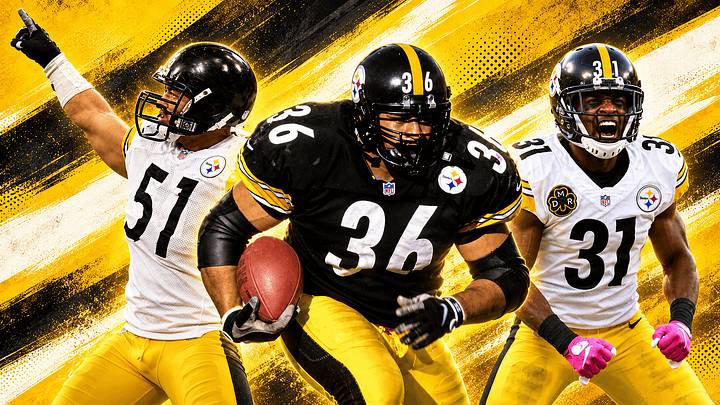
Jerome Bettis, James Farrior, Ryan Clark, and Jeff Hartings are among 25 players whose best NFL chapter came with the Pittsburgh Steelers after they began elsewhere. Pittsburgh acquired them in different ways, but each filled a job that became central to the team, from carrying the offense to holding together a championship defense.
A best chapter doesn’t mean every player arrived as a nobody. Bettis had already been an All-Pro with the Rams, Farrior was productive with the Jets, and Gary Anderson later had a remarkable season in Minnesota. The case for Pittsburgh rests on what each player did here: a sustained peak, a larger role, or work that defined more of his career than any other stop.
The Steelers found these players by recognizing specific jobs for them. Hartings moved from guard to center. Clark paired with Troy Polamalu after Pittsburgh lost a starting safety. Mike Hilton became a weapon from the slot. Some of the moves were obvious only after the player got on the field.
Jerome Bettis, RB
The Rams traded Jerome Bettis in 1996 after drafting Lawrence Phillips, even though Bettis earned All-Pro recognition as a rookie. Pittsburgh had an immediate opening in its backfield following the Super Bowl 30 season. A Still Curtain lookback at 1996 revisits the payoff: 1,431 rushing yards in his first year with the Steelers.
The wheels on the bus go round and round 🚌 pic.twitter.com/Hdk90uGvi6
— Pittsburgh Steelers (@steelers) February 16, 2021
A decade in Pittsburgh produced 10,571 rushing yards, and Bettis finished his career with a storybook ending -- a Super Bowl 40 victory in his hometown of Detroit. His Rams seasons were impressive enough to make this more than a reclamation story. The Steelers gave an established back the workload and time to become the defining runner of their next era.
James Farrior, LB
The Jets drafted James Farrior in the top ten, and he made 175 tackles in his final season with New York. When he joined Pittsburgh in 2002, the Steelers put him in the middle of their 3-4 defense. His arrival wasn’t a bet that the Jets had missed all his talent. It was a decision about where that talent could do the most work.
First-team All-Pro honors came in 2004, and Farrior started for two championship teams during a decade in Pittsburgh. He belongs in any serious discussion of the franchise’s linebackers, as Still Curtain's linebacker history reflects. Pittsburgh’s 2000s defenses had plenty of stars, but Farrior was the inside starter who tied their long run together.
Jeff Hartings, C
Detroit played Jeff Hartings at guard for five seasons before Pittsburgh brought him in to succeed Dermontti Dawson at center. That’s a difficult introduction to a fan base accustomed to excellence at the position. The Steelers trusted a veteran lineman to change jobs while replacing one of the best centers they’d ever had.
By 2004, Hartings had earned first-team All-Pro honors. He made the Pro Bowl that season and the next, then started for the Super Bowl 40 winners. Still Curtain's offensive line history includes him among the franchise’s standouts. He didn’t become another Dawson. He became a dependable center for a new quarterback and a team ready to contend.
Ryan Clark, S
Four NFL seasons with the Giants and Washington preceded Ryan Clark’s arrival in Pittsburgh in 2006. The Steelers needed a starting safety after Chris Hope left, particularly one who could play beside Polamalu, whose game could take him almost anywhere before or after the snap. Clark gave the secondary an experienced partner with responsibilities of his own.
Eight Pittsburgh seasons included starts in both the Super Bowl 43 win and the Super Bowl 45 loss. Clark had been an NFL starter before joining the Steelers, but this was where he built his reputation. Fans can remember Polamalu’s spectacular plays without overlooking how much steadiness the other safety job required.
James Harrison, OLB
A brief stop in Baltimore interrupted James Harrison’s early Steelers career. Pittsburgh originally signed him in 2002 and cut him several times. After the Ravens let him go in 2004, the Steelers brought him back when an injury to Clark Haggans created a training camp opening.
16 years ago today, James Harrison gave us one of the GREATEST moments in Super Bowl history! 🔥 #HereWeGo
— NBC Sports (@NBCSports) February 1, 2025
(via @NFL) pic.twitter.com/HzCvu9lXlr
That second Steelers chance led to the 2008 Defensive Player of the Year award and Harrison’s 100-yard interception return in Super Bowl 43. Pittsburgh had already seen him up close and let him go. His career became one of the franchise’s strongest examples of a player developing well beyond its first evaluation.
Mike Hilton, CB
Jacksonville released Mike Hilton in 2016, and he spent a short time on New England’s practice squad before joining Pittsburgh’s practice squad late that year. The Steelers' account of Hilton's arrival lays out how little NFL footing he had before he made the team in 2017.
Four sacks and two interceptions followed in 2017 as Pittsburgh used Hilton aggressively from the slot. His later work in Cincinnati deserves respect, so there’s no need to pretend he played well in only one place. The Steelers gave him his first substantial role, where his tackling and blitzing could alter an offense’s plan.
Alejandro Villanueva, OT
Philadelphia brought Alejandro Villanueva to camp in 2014 as a defensive lineman. Pittsburgh signed him to its practice squad and developed him at offensive tackle. When Kelvin Beachum was injured in 2015, Villanueva took over at left tackle and kept the job.
Two Pro Bowls followed while Villanueva protected Ben Roethlisberger’s blind side. His height and background made the position change unusual, but staying there was the harder achievement. An experiment that could’ve ended on the practice squad became a six-season run as a starting tackle.
Minkah Fitzpatrick, S
Miami traded Minkah Fitzpatrick to Pittsburgh two games into the 2019 season. Roethlisberger was already lost for the year, and the Steelers needed their defense to keep games within reach. Fitzpatrick intercepted five passes that season, giving the secondary the range and takeaways it had lacked.
MINKAH FITZPATRICK: 96-YARD PICK 6!
— NFL (@NFL) November 3, 2019
3 INTs in the last 6 days 👀 @minkfitz_21 #INDvsPIT
📺: CBS
📱: NFL app // Yahoo Sports app
Watch free on mobile: https://t.co/GjhTr4sGG6 pic.twitter.com/aEfxFO842N
First-team All-Pro honors followed in 2019, 2020, and 2022 before returning to Miami in a 2025 trade. The Dolphins had drafted a gifted safety; the Steelers got his finest sustained run. His work also showed why trading a first-round pick can be justified when a player immediately solves a real weakness.
Chris Boswell, K
Stints with Houston and the Giants preceded Chris Boswell’s arrival during Pittsburgh’s 2015 kicking problems. He followed Josh Scobee into a job that had already cost the Steelers points. Boswell settled in quickly and became a fixture, including a six-field-goal playoff win at Kansas City after the 2016 season.
His rough 2018 season belongs in the story, too. Boswell recovered and made 41 of 44 field goals in 2024, earning first-team All-Pro honors. Still Curtain's Steelers kicker rankings provide the franchise comparison. His peak came years after that desperate midseason call.
Gary Anderson, K
Buffalo drafted Gary Anderson and cut him before the 1982 season. Pittsburgh picked him up and got 13 seasons of kicking, 1,343 points, and a 1985 first-team All-Pro selection. For a franchise that would later endure some sharp swings at the position, that length of service is part of his case.
A perfect 1998 regular season with Minnesota was an extraordinary late peak. It doesn’t erase Anderson’s much longer chapter in Pittsburgh. Steelers fans watched him develop from a discarded rookie into an established kicker, then keep playing well after he left.
John Henry Johnson, FB
The Steelers drafted John Henry Johnson in 1953, but he went to Canada before playing for San Francisco and Detroit. Pittsburgh finally acquired him in a 1960 trade. The Steelers' John Henry Johnson profile documents a winding path back to the team that first selected him.
In 1962, Johnson became the franchise’s first 1,000-yard rusher. He reached that mark again in 1964 and made three Pro Bowls over his six seasons in Pittsburgh. His best work arrived after he’d already established himself elsewhere, a reminder that the Steelers’ history of benefiting from another team’s veteran goes back well before free agency.
Tom Tracy, RB
Tom Tracy spent two full seasons with Detroit before he joined Pittsburgh in 1958. In his first season with the Steelers, he rushed for 714 yards and added 535 receiving yards. That was substantial work through both parts of the offense in a 12-game season.
Pro Bowl selections followed in 1958 and 1960. The Steelers didn’t have a championship run to attach to Tracy’s name, which is probably why he gets less attention than later backs. In Pittsburgh, his varied skills became a key part of the offense.
Clendon Thomas, DB
Clendon Thomas spent four seasons with the Rams before his 1962 trade to Pittsburgh. He made eight interceptions in 1963 and earned a Pro Bowl selection. Over seven Steelers seasons, he recorded 23 interceptions while playing cornerback and safety.
The Steelers also used Thomas on offense, catching 42 passes for 765 yards. His Pittsburgh chapter can’t be measured by defensive takeaways alone. He gave the team two-way help that looks especially unusual to anyone accustomed to modern, specialized rosters.
Ray Mansfield, C
Philadelphia drafted Ray Mansfield as a defensive tackle in 1963 and traded him to Pittsburgh after one season. He started at defensive tackle for the Steelers, then switched to center in 1966. That move gave Pittsburgh a long-term starter well before its first Super Bowl roster took shape.
A streak of 182 consecutive regular-season games carried Mansfield through the franchise’s first two championship teams, both of which he started at center. The position switch also began his place in a remarkable line of Steelers centers that later included Mike Webster and Dawson. Mansfield arrived before the dynasty and helped hold its early offensive line together.
John Fuqua, RB
The Giants traded John Fuqua to Pittsburgh in 1970, and he became a starting halfback. As a Steeler, he rushed for 2,942 yards, averaging 4.2 yards per carry. He contributed before Harris arrived and continued as Pittsburgh’s backfield changed around him.
The Immaculate Reception often reduces Fuqua’s story to his role as Bradshaw’s intended receiver. That famous play can obscure the years of rushing production that earned him a spot in the lineup. He also stayed with the Steelers for their first two Super Bowl titles, even as Harris took over the leading role.
Duval Love, G
Seven seasons with the Rams gave Duval Love an NFL starting résumé before Pittsburgh added him in 1992 under the league’s old Plan B free-agency system. He joined a running game that needed strong interior blocking, and Barry Foster rushed for 1,690 yards in Love’s first Steelers season.
Love’s lone Pro Bowl selection came in 1994, when Pittsburgh ran for 2,180 yards as a team. His Rams career had already proved he belonged in the league. His years with the Steelers gave him his clearest individual recognition and made him a major part of Bill Cowher’s early playoff teams.
Yancey Thigpen, WR
San Diego gave Yancey Thigpen only a brief look in 1991 before Pittsburgh signed him the following season and initially used him on special teams. By 1995, he led the Steelers with 85 catches for 1,307 yards as the team reached Super Bowl 30.
In 1997, Thigpen caught 79 passes for 1,398 yards and earned his second Pro Bowl selection. Those were big passing numbers for Cowher teams that could lean heavily on the run. A player who entered Pittsburgh on the edge of the roster became the receiver opposing defenses had to plan for.
Dewayne Washington, CB
Four seasons in Minnesota gave Dewayne Washington starting experience before he joined the Steelers in 1998. He played outside corner in Pittsburgh for six seasons and intercepted 19 passes. In his first year, he returned two interceptions for touchdowns against Jacksonville in the same game.
Six years as a starter and that production make a strong case, even without the individual honors some names here got. Pittsburgh needed outside corners who could hold up in its defense while the pass rush attacked. Washington gave the Steelers one through several playoff runs, including the 2001 AFC title game appearance.
Kimo von Oelhoffen, DL
Kimo von Oelhoffen spent six seasons in Cincinnati before moving to Pittsburgh in 2000. He began at nose tackle, then moved to defensive end after the Steelers added Casey Hampton. That flexibility let Pittsburgh use both linemen in its three-man front.
Eight sacks in 2003 showed another side of von Oelhoffen’s game, and two seasons later he started for the Super Bowl 40 winners. His work against the run was less likely to make a highlight reel than the pressure from the outside linebackers, but the front needed someone who could do that job. Pittsburgh gave him a role that let him use his full range.
Tommy Maddox, QB
Denver, the Rams, and the Giants had all employed Tommy Maddox before he left the NFL. After succeeding in the XFL, he joined Pittsburgh and eventually replaced Kordell Stewart as the starter in 2002. Maddox threw 20 touchdown passes that season.
His comeback against Cleveland in the 2002 playoffs, after Pittsburgh trailed 24-7, gave the Steelers a postseason win during the gap between Stewart and Roethlisberger. Maddox’s turnover problems and Roethlisberger’s emergence limit the case for him as a lasting answer. They don’t diminish how much more he accomplished in Pittsburgh than at his earlier NFL stops.
Roosevelt Nix, FB
College defensive lineman Roosevelt Nix failed to make Atlanta’s roster while trying fullback. Pittsburgh initially brought him in as a linebacker in 2015, then moved him back to fullback when it needed one. He finally found a regular NFL job.
Bell rushed for 1,291 yards in 2017 with Nix helping clear the way. Nix also made 10 special teams tackles and received a Pro Bowl selection for that season. He barely touched the ball, which is exactly why his place here needs explaining. The Steelers found steady use for him in blocking and coverage, two jobs that kept him active on game days.
Vance McDonald, TE
San Francisco used Vance McDonald for four seasons before Pittsburgh traded for him ahead of 2017. His first Steelers season was uneven, but he led the team in tight ends in 2018 with career highs of 50 catches and 610 yards.
Antonio Brown and JuJu Smith-Schuster both had more than 100 catches that year, so McDonald’s production came in a passing game with two obvious receiving priorities. He moved ahead of Jesse James as the main tight end target and gave Roethlisberger another way to punish defenses focused on the wideouts.
Chris Wormley, DL
Baltimore traded Chris Wormley to Pittsburgh in 2020. He was a useful reserve at first, but the Steelers needed more from him in 2021, with Stephon Tuitt unavailable and Tyson Alualu injured early in the season. Wormley responded with 51 tackles and seven sacks, both career highs.
Those sacks don’t mean Wormley became Pittsburgh’s best defensive lineman; Heyward still carried that distinction. Wormley gave the Steelers a capable starter when their expected front had fallen apart. His strongest NFL season came because he handled more responsibility than he’d had in Baltimore.
Miles Killebrew, S
Five seasons with Detroit established Miles Killebrew primarily as a special teamer before he joined Pittsburgh in 2021. The Steelers made that work a central part of his job. His blocked punt against Baltimore in 2023 went out of the end zone for a safety in a 17-10 Steelers win.
First-team All-Pro recognition as a special teamer followed for that season. A safety doesn’t need to become a defensive starter for his career to reach another level. Pittsburgh gave Killebrew chances to affect field position and scoring on the units where he does his best work.
Kenneth Gainwell, RB
A Super Bowl win as a Philadelphia reserve preceded Kenneth Gainwell’s career highs in Pittsburgh in 2025. He rushed for 537 yards, caught 73 passes for 486 more, and his teammates voted him the Steelers’ team MVP by his teammates. The Steelers' 2025 running back review also highlights his work on kickoff returns.
Jaylen Warren remained Pittsburgh’s leading rusher with 958 yards, while Gainwell led the team in receptions. That division of work explains his best season better than calling him the lead back would. Gainwell moved to Tampa Bay in 2026, leaving the Steelers with a brief chapter in which he had a bigger receiving role than Philadelphia had given him.
 Add us as a preferred source on Google