

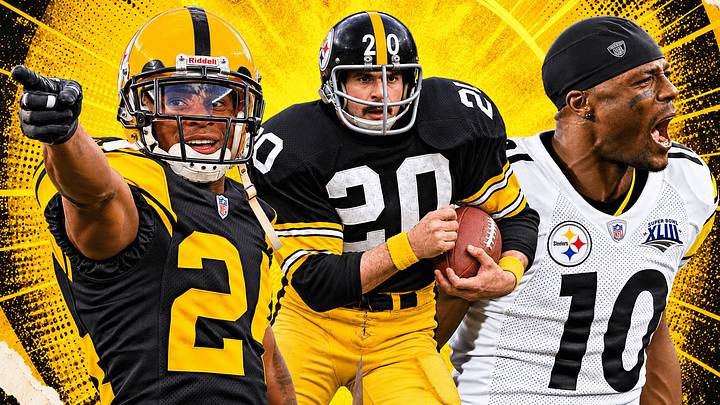
Ike Taylor, Santonio Holmes, and Rocky Bleier are among 25 Pittsburgh Steelers who never made a Pro Bowl despite helping championship teams win. Taylor drew difficult coverage assignments, Holmes caught a Super Bowl winner, and Bleier rushed for 1,000 yards while blocking for Franco Harris.
In August 2026, the NFL announced it would stop staging the Pro Bowl game and its skills contests, ending a 75-year tradition of all-star competition. The league will still name 88 Pro Bowlers each season.
For decades, a Pro Bowl selection was a prized individual honor. As replacement call-ups multiplied, fans had reason to question whether every name on the roster met the same standard as an original pick. Those replacement spots still count in the historical record, and none of these 25 players earned one with Pittsburgh or another club.
Some omissions look like genuine misses. Others show how an individual honor can overlook lead blocking, difficult coverage assignments, and a reserve keeping a defense steady when a starter goes down. These Steelers mattered in different ways, and their cases deserve to be judged that way.
Ike Taylor, CB
By 2005, Ike Taylor had become the corner Pittsburgh trusted with many of an opponent's best receivers. He started for the Super Bowl 40 and 43 winners and stayed in that role as the defense around him changed. Still Curtain's cornerback history places him among the franchise's best at the position.
Taylor finished with 14 interceptions, a modest total for someone who spent so long as a starting corner. He also had to keep covering when a quarterback went back to the same matchup after a completion. His case rests on that sustained trust and the coverage he provided, rather than a claim that the takeaway total was secretly impressive.
Santonio Holmes, WR
With 35 seconds left in Super Bowl 43, Santonio Holmes caught the six-yard touchdown that put Pittsburgh ahead of Arizona. He finished with nine catches for 131 yards and earned game MVP honors. The NFL's account of Holmes' catch also shows how much of the winning drive ran through him.
On this day in 2009, Santonio Holmes made an all-time catch to win Super Bowl XLIII. (via @NFLThrowback)@ToneTime10 | @steelers pic.twitter.com/uP86Qbrt7M
— NFL (@NFL) February 1, 2022
One catch can dominate a player's reputation, but Holmes followed that season with 1,248 receiving yards in 2009. He could create after the catch and answer Ben Roethlisberger when a play broke down. His Pittsburgh stay was relatively short; his best two seasons were substantial.
Rocky Bleier, RB
In 1976, Rocky Bleier rushed for 1,036 yards while Franco Harris ran for 1,128. Pittsburgh had two 1,000-yard backs in a 14-game season, and Bleier also led the blocking that helped Harris get to the second level.
Bleier's return from wounds suffered in Vietnam gives his career an extraordinary human story. His football contribution holds up on its own. He played on all four 1970s championship teams, took carries when the offense needed them, and did the less celebrated work that let another back become the featured runner.
Jon Kolb, OT
For all four of Pittsburgh's 1970s Super Bowl wins, Jon Kolb started at left tackle. Terry Bradshaw needed time for the deep passing game, and the Steelers needed their tackles to block for Harris and Bleier. Kolb held that job through the full championship run.
A ring doesn't prove that every starter was great. Thirteen seasons at tackle, including starts in four title games, make a stronger case for Kolb than the ring count by itself. Still Curtain's offensive line history gives him his due, even though Pro Bowl voters never did.
Ray Mansfield, C
Before Mike Webster took over at middle linebacker, Ray Mansfield started at center for the Super Bowl 9 and 10 winners. He had arrived from Philadelphia as a defensive tackle and switched positions with the Steelers in 1966. He then played 182 consecutive regular-season games, a franchise record.
Mansfield even kicked two extra points in the 1976 playoffs after Roy Gerela injured his groin. The first came in a win over Baltimore; the second came in the AFC Championship Game loss to Oakland. Those kicks are a fine bit of Steelers history, though his long run at center is why he belongs here.
Ernie Holmes, DT
The original Steel Curtain front four included Ernie Holmes alongside Joe Greene, L.C. Greenwood, and Dwight White. Holmes started on the defensive line for Pittsburgh's first two Super Bowl winners, yet he was the member of that group who never made a Pro Bowl.
Holmes also played before sacks became an official NFL statistic in 1982, so a modern stat line leaves out part of his pass-rushing work. His place on that front doesn't mean he had Greene's career. It does mean the defense's most famous unit had an essential starter without the honor often used to identify its stars.
Randy Grossman, TE
Randy Grossman's touchdown catch tied the score at 7 in Super Bowl 10 against Dallas. He was an undrafted tight end on all four Pittsburgh championship teams, working in an offense that asked the position to block as well as catch passes.
When Bennie Cunningham was injured in 1978, Grossman took on a larger receiving role and caught a career-high 37 passes. That season better shows his range than the Super Bowl touchdown alone. Pittsburgh could use him as a blocker on one drive and ask him to help replace a starting receiver on the next.
Dwayne Woodruff, CB
A sixth-round pick in 1979, Dwayne Woodruff recorded 37 interceptions during his Steelers career. His rookie season brought a Super Bowl ring; his later years brought the harder assignment of keeping Pittsburgh's secondary productive as the great 1970s defense aged.
Woodruff became a regular starter and was the team's MVP in 1982. His career sits between the eras of Mel Blount and Rod Woodson, which can make it easy to overlook. Thirty-seven takeaways give fans a good reason to stop and look at what he did in between.
Bryan Hinkle, OLB
From 1984 through 1991, Bryan Hinkle started 113 games at outside linebacker. Across that stretch, the Steelers credited him with 21.5 sacks, 15 interceptions, and 11 fumble recoveries. Pittsburgh's history of sixth-round picks puts those figures beside his lack of a Pro Bowl selection.
Hinkle could rush, drop into coverage, and finish plays when the ball came loose. He played through a stretch when Pittsburgh was searching for its next great team, so he never got the championship exposure many names on this list did. The production still stands on its own.
Keith Willis, DE
Fourteen sacks in 1983 put Keith Willis among the most productive defensive ends Pittsburgh has had since the NFL began officially recording sacks. He added 12 in 1986 and finished his Steelers career with 59. The Steelers' defensive line review puts those seasons in rare company for the franchise's linemen.
Willis joined Pittsburgh undrafted in 1982, after the original Steel Curtain had gone. His teams couldn't borrow that group's reputation, and his pass-rushing numbers shouldn't need it. Two seasons above 10 sacks from a defensive end are a serious contribution in any Steelers era.
Merril Hoge, RB
Pittsburgh's 1989 playoff run gave Merril Hoge back-to-back 100-yard rushing games. He ran for 100 in an overtime win over Houston, then 120 in a one-point loss at Denver. The second game ended the season, but it showed the offense could travel and move the ball against a strong opponent.
Hoge also gave the Steelers a useful receiver out of the backfield, catching 50 passes in 1988. Between the 1970s dynasty and Bill Cowher's winning teams, he offered more than a single way to gain a first down. That versatility made him valuable even when Pittsburgh had less talent around him.
Darren Perry, S
Six interceptions as a rookie in 1992 announced Darren Perry's arrival in Bill Cowher's secondary. He collected 32 picks in seven Steelers seasons and started in Super Bowl 30, helping bridge the defenses led by Rod Woodson and the later units that took Pittsburgh back to title games.
Perry's 32 Steelers interceptions equal Troy Polamalu's franchise total, though the two safeties played different roles and Polamalu stayed much longer. The comparison doesn't claim their careers were equal. It shows how often Perry found the ball during his comparatively brief Pittsburgh run.
Plaxico Burress, WR
Back-to-back 1,000-yard seasons in 2001 and 2002 established Plaxico Burress as a major part of Pittsburgh's passing game. He had 1,325 yards in 2002 as the offense moved from Kordell Stewart to Tommy Maddox at quarterback.
.@mvp86hinesward with the gadget play 😮💨
— Pittsburgh Steelers (@steelers) June 22, 2026
🎥 https://t.co/XL7UQsbZDF pic.twitter.com/MALDSawXwr
Burress gave those quarterbacks a large target opposite Hines Ward, especially when a throw had to be made with a defender close. He later caught the winning touchdown for the Giants in Super Bowl 42, but never made a Pro Bowl with either team. His Steelers years deserve more than a footnote before that famous New York finish.
Deshea Townsend, CB
A fourth-round pick in 1998, Deshea Townsend spent 12 seasons in Pittsburgh and intercepted 21 passes as a Steeler. He became a starter opposite Taylor on the Super Bowl 40 team and contributed to the secondary when Pittsburgh won Super Bowl 43.
Townsend's role changed as other corners arrived, and he kept finding a place in the defense. Those adjustments are part of his case. A long-term starter who can also handle a smaller role gives a coordinator options when injuries or matchups force a change.
Kimo von Oelhoffen, DL
After six seasons with Cincinnati, Kimo von Oelhoffen joined Pittsburgh in 2000 and started at nose tackle. The Steelers moved him to defensive end when Casey Hampton arrived, giving him useful work at two demanding spots in their three-man front.
Von Oelhoffen started every playoff game he played for Pittsburgh, including the Super Bowl 40 win over Seattle. His job at end included holding up against the run while the outside linebackers pursued the quarterback. The move from nose tackle helped the Steelers field Hampton without losing a dependable veteran up front.
Dan Kreider, FB
Jerome Bettis and Willie Parker ran the ball differently, and Dan Kreider spent years leading the way for both. The undrafted fullback arrived in 2000 and stayed in the offense as Pittsburgh shifted from Bettis' power to Parker's speed.
Kreider's assignment usually began before the runner reached the line. A clean block could decide whether Bettis got the yardage he needed or Parker reached an opening with room to accelerate. Neither outcome added much to a fullback's stat sheet, but both were part of the Steelers' 2005 championship offense.
Chris Hoke, NT
When Casey Hampton was injured in 2004, Chris Hoke stepped into a starting nose tackle job on a defense with Super Bowl ambitions. The undrafted reserve had spent years preparing for a role that rarely belonged to him on Sundays.
Pittsburgh went 17-1 in Hoke's 18 regular-season starts across his career, according to the Steelers' Chris Hoke retirement account. That's a team record, not a statistic proving he won those games himself. It shows the defense kept functioning when its starting nose tackle was unavailable, which is exactly what Pittsburgh needed from him.
Larry Foote, ILB
A fourth-round pick in 2002, Larry Foote became a starting inside linebacker on both Pittsburgh championship teams of that decade. He played alongside James Farrior in a defense with celebrated pass rushers and defensive backs, taking on the weekly run and coverage responsibilities in the middle.
Foote spent 2009 with Detroit, returned to Pittsburgh, and later took on a bigger role in communicating the defense after Farrior's departure. Still Curtain's Steelers linebacker history includes him for good reason. He gave the team a starter during its title years and a veteran it could turn to again afterward.
Clark Haggans, OLB
Nine regular-season sacks in 2005 gave Clark Haggans a meaningful share of Pittsburgh's pass rush on the way to Super Bowl 40. He added a sack against Seattle in the championship game while playing opposite Joey Porter.
Porter drew more attention and more honors, but a defense rushing from both edges couldn't leave the opposite tackle alone all afternoon. Haggans gave the Steelers a productive starter there for several seasons. His career continued elsewhere after Pittsburgh; a Pro Bowl selection never came.
Max Starks, OT
Pittsburgh started Max Starks at right tackle in Super Bowl 40 and at left tackle in Super Bowl 43. Those weren't interchangeable jobs. The switch changed which rushers he faced and which side of Roethlisberger's protection he had to secure.
The 2008 offensive line had its rough days, so two rings shouldn't turn Starks into an imaginary flawless blocker. He did give Pittsburgh a tackle it could move across the line and start in another title game. With Roethlisberger often extending plays, keeping that position staffed had practical value.
Jeff Reed, K
For the 2005 and 2008 championship teams, Jeff Reed handled Pittsburgh's field goals and extra points. He scored 919 points as a Steeler and made 204 field goals, a long stretch of production at a position where one miss can dominate the conversation.
The finish complicates his case. Reed made 15 of 22 field-goal attempts in 2010 before the Steelers released him and brought in Shaun Suisham. His late struggles belong in the account of his career, just as his work on two championship teams does. He earned this place without needing to be recast as an overlooked all-time great.
Charlie Batch, QB
Two wins with Charlie Batch filling in at quarterback helped the 2005 Steelers get through a season that ended with a Super Bowl victory. An 11-season Pittsburgh backup couldn't count on steady starts; he had to be ready when Roethlisberger couldn't play.
Batch's 23-20 win at Baltimore in 2012 came one week after a loss in Cleveland in which he threw three interceptions. Both games belong in the story. Pittsburgh got a backup who could recover from a poor outing and beat its biggest rival on the road, even if that season didn't end in another playoff run.
Rashard Mendenhall, RB
The 2010 Steelers reached Super Bowl 45 with Rashard Mendenhall carrying the largest share of the ground game. He rushed for 1,273 yards and 13 touchdowns in the regular season, then added 121 yards against the Jets in the AFC Championship Game.
Mendenhall's fumble against Green Bay in the Super Bowl gave the Packers possession during a close fourth quarter, and Pittsburgh lost. That play can't be edited out of his postseason. Neither can the workload and production that helped get the Steelers there. A costly mistake and a valuable season can both be true.
Ramon Foster, G
Undrafted in 2009, Ramon Foster spent all 11 of his NFL seasons with Pittsburgh and started 145 games. He became a fixture at guard while the Steelers built a line that also featured Maurkice Pouncey and David DeCastro. Still Curtain's Ramon Foster retrospective traces that unlikely path to a long starting career.
Foster's durability gave Pittsburgh something more useful than an occasional standout afternoon. The line could plan around him year after year while tackles changed and younger players developed. He never earned the individual honor some teammates did, but he was a stalwart.
Stephon Tuitt, DE
Eleven sacks in 2020 gave Stephon Tuitt a rare double-digit season for a Steelers defensive lineman. Working with Cameron Heyward, he could push a pocket from the line and force offenses to account for more than Pittsburgh's outside rushers.
Stephon Tuitt takes down Mariota for the Steelers' safety! @DOCnation_7@steelers
— NFL (@NFL) August 26, 2019
📺: #PITvsTEN on NBC pic.twitter.com/ZAT5dH4tn7
Tuitt didn't play in 2021, and Tyson Alualu suffered a season-ending ankle injury early that year. Pittsburgh finished last in the NFL against the run. Those losses don't explain every defensive problem that season, but they left the Steelers replacing two established linemen while opponents kept testing the middle of the front.
 Add us as a preferred source on Google