

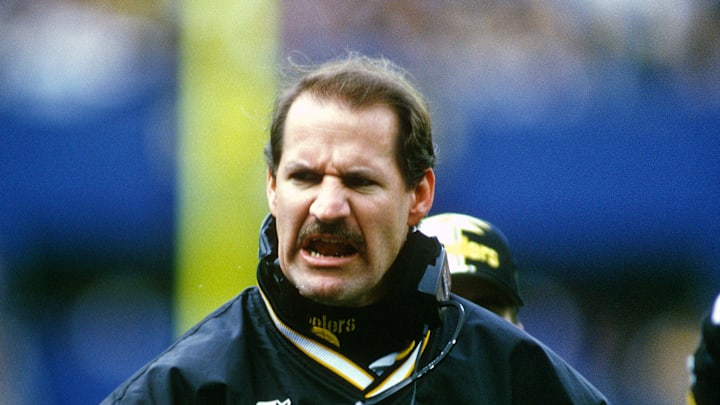
Bill Cowher may no longer be pacing the sidelines for the Pittsburgh Steelers, but one thing was immediately clear during his appearance on The Pat McAfee Show this morning: the former Steelers head coach never really stopped coaching football.
Cowher spoke with the same passion, clarity, and edge that defined his Hall of Fame career. From drawing up plays to staying in constant communication with active coaches, Cowher remains deeply embedded in the game. Football is not something he used to do. It is still very much who he is.
Bill Cowher made many important points on The Pat McAfee Show that the Pittsburgh Steelers must take notice of
Still Coaching, Still Teaching
Cowher revealed that he continues to diagram plays and send concepts to coaches across the league. That detail alone speaks volumes. His love for teaching, problem solving, and schematic evolution has not faded with time. Instead, it has adapted.
More importantly, Cowher emphasized that coaching is not just about the play call. It is about teaching players why they are doing something. That philosophy became a cornerstone of his success in Pittsburgh and remains, in his view, essential for building trust and long-term success in today’s NFL.
When players understand the why, Cowher explained, they play faster, freer, and with confidence. Trust allows players to be themselves. And when players can be themselves, teams reach their highest ceiling.
Lessons From the Past: Hiring Within the System
One of the most compelling moments from Cowher’s appearance came when he reflected on his own mistakes as a head coach. Cowher admitted that he struggled when he hired outside of his system early in his tenure. Success, he said, came when he committed to developing coaches from within.
He specifically cited offensive coordinators Mike Mularkey and Ken Whisenhunt as examples of internal hires who understood the Steelers’ culture and philosophy. Those hires helped stabilize the staff and ultimately contributed to sustained success.
It was a subtle but pointed observation, especially when contrasted with Mike Tomlin’s long-standing reluctance to hire coordinators from within the Steelers’ pipeline. Cowher’s message was clear: continuity, alignment, and shared vision matter.
Culture Is Not a Buzzword. It Is the Foundation
Cowher repeatedly returned to one central theme: culture.
He spoke about how championship teams are built by identifying the right people, not just talented players, but players who fit what he called your guys. Cowher pointed to Mike Vrabel as a prime example, explaining how Vrabel quickly established a standard and found Mike Vrabel guys to bring that culture to life.
Cowher also referenced how quickly coaches like Vrabel in New England and Mike Macdonald in Seattle have been able to shift organizational direction. The common thread is clarity of purpose, accountability, and belief.
To Cowher, culture is not motivational slogans or branding. It is a daily behavior, reinforced through teaching and trust.
Breaking the Will of the Opponent
Another classic Cowher moment came when he discussed winning in big games. His philosophy remains unchanged: to win at the highest level, you must break the will of your opponent.
That does not happen accidentally. It comes from preparation, physicality, and belief in what you are doing. It comes from players trusting their coaches and coaches trusting their players.
That mindset defined the Steelers during Cowher’s tenure and remains a standard the franchise continues to chase.
Steelers Coaching Search and a Yinzer Shoutout
Cowher also touched on the Steelers' head coaching conversation, noting that he spoke with Mike McCarthy just yesterday. While he did not speculate heavily, his comments reinforced the importance of leadership, communication, and cultural alignment over scheme alone.
Before wrapping up, Cowher gave credit where it was due, offering praise to fellow Yinzer Curt Cignetti for winning the National Championship. It was a reminder that great coaching, regardless of level, always comes back to the same principles.
A Standard That Still Matters
Bill Cowher’s appearance was not nostalgic. It was instructive. His insights remain relevant because the foundation of winning football has not changed.
Teach the game.
Hire people who believe in your system.
Build trust.
Establish culture.
Break your opponent’s will.
Cowher may no longer wear a headset on Sundays, but the standard he helped build in Pittsburgh is still very much alive, and his voice still carries weight in a league searching for exactly what he has always understood.
 Add us as a preferred source on Google