

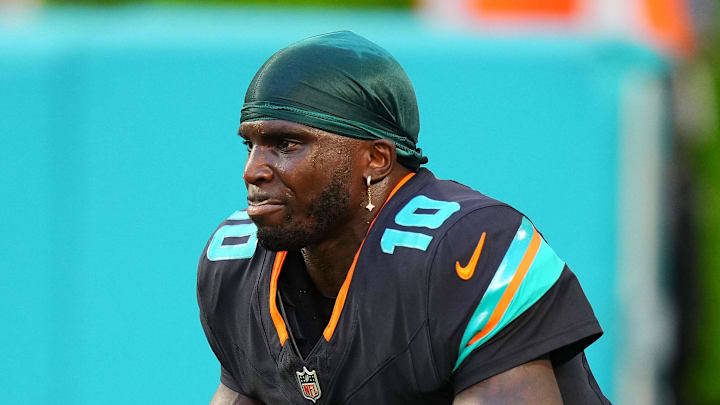
The moment the Miami Dolphins released Tyreek Hill, my first thought wasn’t about South Beach. It was about the Pittsburgh Steelers.
For a franchise searching for offensive clarity, this felt like an unexpected gift.
Omar Khan is already one of the busiest executives in football. After last season’s collapse, the mandate is clear: restructure without detonating the foundation. With the NFL Draft approaching, the Steelers are carefully examining every lever they can pull to maximize their competitive window. Adding Hill to the equation would certainly qualify as bold — and potentially brilliant.
Improving the offense is no longer just a plea from frustrated fans. It is the blueprint for Mike McCarthy and his new staff. McCarthy is a seasoned offensive mastermind. He was brought in to modernize a unit that has lagged behind contenders.
The issue? He currently has limited weaponry.
Yes, DK Metcalf provides star power and physical dominance on the outside. But beyond him, Pittsburgh has yet to establish a dependable secondary option. Calvin Austin has delivered clutch moments — the kind that spark stadium eruptions — yet consistency remains elusive. Defenses know this. They scheme for it.
Hill changes that math instantly.
Before injuries derailed his season, Hill recorded 21 receptions for 265 yards and a touchdown. A dislocated left knee and ACL tear ended his campaign prematurely — a serious setback for a receiver whose game revolves around speed and separation. That reality cannot be ignored. Betting on a 30-plus receiver coming off a major knee injury is the very definition of risk.
But sometimes calculated risks separate stagnant franchises from aggressive contenders.
The Pittsburgh Steelers need to evaluate aquiring Tyreek Hill before the NFL Draft
Financially, the situation is complicated. According to Spotrac, Hill was projected to carry a 16.45% cap hit in 2026 under his previous structure. That figure alone makes a traditional acquisition unrealistic. Pittsburgh already committed significant resources to Metcalf with a four-year, $132 million deal last offseason. Doubling down on another high-priced veteran would not sit well in every corner of the fanbase — nor should it.
However, this is where Khan’s creativity matters.
If Hill truly wants to land in a competitive environment and the Steelers see mutual value, restructuring compensation into a performance-based, incentive-laden deal could bridge the gap. A shorter-term agreement with flexibility would protect Pittsburgh while giving Hill the platform to reestablish his market value.
From a football perspective, the fit is tantalizing. Hill’s vertical gravity would open space for Metcalf underneath and across the middle. It would ease pressure on the quarterback — whether that remains a veteran bridge or a younger developing option. Most importantly, it would send a message that Pittsburgh refuses to accept offensive mediocrity.
READ MORE: Steelers cannot afford to overcomplicate the perfect NFL draft scenario
Still, this cannot be desperation disguised as ambition.
The NFL Draft is loaded with young, explosive receivers eager to prove themselves. Cost-controlled talent matters, especially for a roster attempting to balance experience with sustainability. Overreaching for a splash move could undo the careful recalibration Pittsburgh claims to be executing.
I see the intrigue. Hill is a competitor. He brings playoff experience and an edge that aligns with Pittsburgh’s culture. If the numbers align and medical evaluations inspire confidence, the partnership could be electric.
But only if it is disciplined.
The Dolphins may have opened the door. Now it is up to the Steelers to decide whether stepping through it elevates their future — or complicates it.
 Add us as a preferred source on Google