

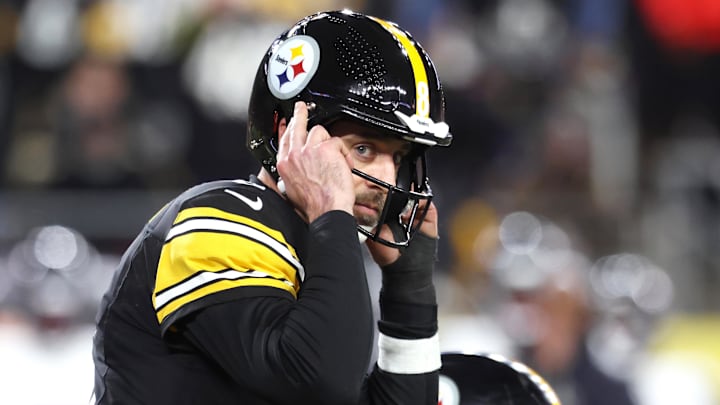
The offseason often feels like a high-stakes chess match, and few front offices embrace that reality as well as the Pittsburgh Steelers. General Manager Omar Khan has built a reputation for patience and precision, carefully weighing each move for both immediate impact and long-term stability.
But even the most calculated strategies must adjust when the rest of the league makes its own plays.
The latest ripple came when the Las Vegas Raiders secured veteran quarterback Kirk Cousins on a one-year deal, subtly reshaping the quarterback market and reinforcing a philosophy Pittsburgh already knows well.
According to Spotrac, Cousins’ agreement is structured to be financially flexible, paying him $11.3 million with a potential $20 million cash outcome, while the Atlanta Falcons absorb part of the financial burden. It’s a smart, measured move by Las Vegas—one designed to shelter and develop a young, promising quarterback like Fernando Mendoza without overwhelming him too early.
It’s also a blueprint that should feel very familiar in Pittsburgh.
Just one year ago, the Steelers executed a similar plan when Khan brought in Aaron Rodgers on a one-year, $13.5 million deal. At the time, the move wasn’t just about wins and losses—it was about guidance. Rookie quarterback Will Howard entered the league with expectations, but more importantly, he entered with a mentor who had seen everything the NFL could throw at him.
And that’s where the conversation becomes intriguing heading into the 2026 season.
On paper, it may seem counterintuitive to consider bringing Rodgers back. He’s no longer the MVP-caliber player who once dominated defenses weekly. Age is undefeated, and the Steelers are clearly transitioning toward a younger future. But leadership, experience, and football intelligence don’t simply fade—they evolve. Rodgers proved last season that while he may not carry an offense for 17 games, he can still operate efficiently when called upon.
More importantly, his presence off the field might be even more valuable than his production on it.
Aaron Rodgers' return to the Pittsburgh Steelers makes more sense after Kirk Cousins' deal with the Raiders
For Howard, another year alongside Rodgers could be transformative. Quarterback development in the NFL is rarely linear, and even the most talented prospects benefit from time, patience, and mentorship. Watching Rodgers prepare, adjust, and dissect defenses offers a masterclass that no playbook can replicate. It’s the kind of learning that happens in meeting rooms, on practice fields, and during quiet in-game moments.
The Raiders are attempting to create that same developmental cushion for Mendoza. Pittsburgh already has it within reach.
Of course, there’s a balance to strike.
The Steelers cannot afford to stall Howard’s growth by clinging too tightly to the past. This is, without question, a franchise preparing to turn the page. But re-signing Rodgers doesn’t have to contradict that vision—it can support it. In a limited role, Rodgers becomes less of a fallback option and more of an on-field extension of the coaching staff, especially under a new regime led by Mike McCarthy.
Financially, the decision would also need to make sense. Pittsburgh isn’t in a position to overspend on a veteran quarterback who won’t be the full-time starter. But if Rodgers is willing to return on another team-friendly deal, the value becomes undeniable.
Ultimately, the Steelers are building toward something sustainable. They’re not just chasing wins—they’re cultivating stability at the most important position in football. If bringing back Aaron Rodgers helps Will Howard take that next step, then the answer becomes simple.
Sometimes, the best move forward is keeping the right piece on the board just a little longer.
 Add us as a preferred source on Google