

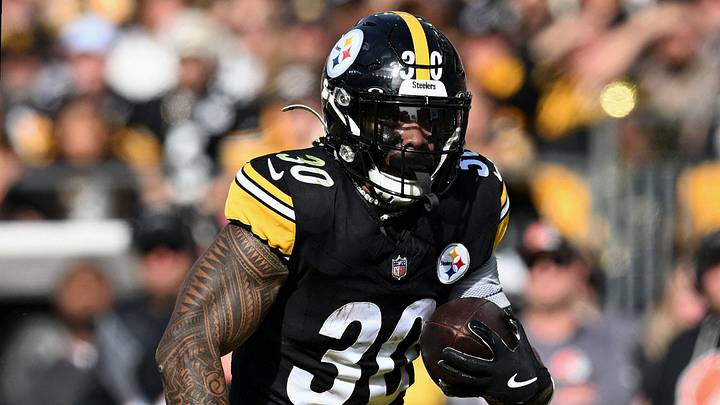
The Pittsburgh Steelers didn't simply run over Cleveland on Sunday. They showed that Mike McCarthy's rushing attack is getting deeper, more adaptable, and considerably harder to defend than the version Pittsburgh opened the season with.
Pittsburgh finished its 27-6 win over the Browns with 200 rushing yards on 33 attempts, averaging 6.1 yards per carry. Jaylen Warren supplied the fireworks with 143 yards and a touchdown on 17 carries, while Rico Dowdle added 56 yards and a score on 15 attempts.
The production was impressive, but McCarthy's explanation revealed why it may be sustainable. Pittsburgh didn't stumble into a ground-heavy game because the score allowed it. "We wanted to run the ball. It was a focal point today," McCarthy said. The Steelers entered the afternoon intending to test Cleveland on the ground, then had enough answers to keep doing it.
Pittsburgh Steelers rushing attack is becoming more than Jaylen Warren
Warren remains the best runner in this backfield, and Sunday offered another argument against treating the workload as an equal partnership simply for symmetry's sake. His 51-yard run was the longest rush of the game, and his 8.4 yards per attempt dwarfed Dowdle's 3.7. Warren has now produced 561 rushing yards through seven appearances, averaging 5.5 yards per carry.
Pittsburgh's earlier backfield debate looks different when Dowdle can handle 15 carries without forcing Warren into a 25-touch afternoon. McCarthy has wanted this structure since the offseason. Running backs coach Ramon Chinyoung Sr. said in May that McCarthy wanted "two fresh backs at all times," with the distribution shifting based on scheme and game plan.
Week 8 looked like that idea operating at full volume.
"It starts up front, obviously, but we got two dynamic backs," McCarthy said afterward. "It’s important for those two men to touch the ball each and every week."
Coach McCarthy spoke to the media after our win over the Browns. @Acrisure pic.twitter.com/h8eyTV4mXQ
— Pittsburgh Steelers (@steelers) November 1, 2026
Warren doesn't have to surrender his status as Pittsburgh's primary weapon for Dowdle to become valuable. The Saints' win already hinted at that balance when Warren ran 18 times for 101 yards, and Dowdle handled nine carries for 41. Cleveland turned the idea into something much more substantial.
McCarthy also described the Browns' plan in schematic terms, noting Pittsburgh's use of trap concepts, additional pattern schemes, and a growing offensive menu. That's the most encouraging piece of the whole afternoon. A first-year system often starts with getting everyone to execute the core calls correctly. Eight games in, Pittsburgh appears increasingly capable of choosing concepts because they attack a particular defensive front rather than merely calling the runs everybody knows best.
Cleveland was a promising test, not definitive proof. Warren drove most of the production, Dowdle was much less efficient, and tougher fronts will challenge whether Pittsburgh can create the same opportunities when the matchup isn't as inviting. The Browns entered the game in the bottom half of the league against the run.
But Pittsburgh now enters its bye at 6-2 and atop the AFC North with evidence that this is becoming more than a generic commitment to "establishing the run." The official game numbers showed 200 rushing yards. McCarthy's explanation showed something potentially more valuable in the form of two backs with defined weekly roles and a run menu that keeps expanding deeper into the season.
 Add us as a preferred source on Google