

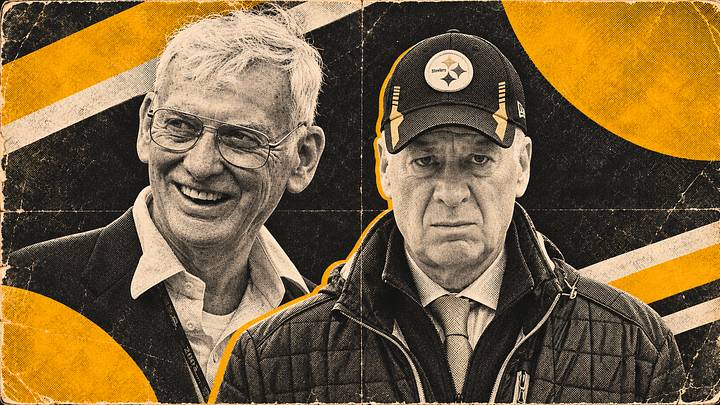
The Pittsburgh Steelers are releasing Aaron Rodgers following his public dismantling of head coach Mike McCarthy, delivering another embarrassing chapter in the franchise's increasingly troubling history since Dan Rooney died in April 2017.
The day before Thanksgiving, at a time when people should be thankful, Rodgers was the opposite. After finding out from a teammate on Tuesday night that he had been benched, Rodgers was scorned, and hell hath no fury. The Pittsburgh Steelers -- particularly longtime coach and friend, Mike McCarthy -- were in his way.
Less than a day after Pittsburgh announced Rodgers' surprise benching, the four-time NFL MVP appeared on "The Pat McAfee Show" and aired grievances about McCarthy's preparation, attentiveness during meetings, communication with players, and handling of the offense. A reunion between a quarterback and coach who won a Super Bowl together has devolved into a public embarrassment for one of professional sports' most historically respected organizations.
According to reporting from ESPN's sources, multiple league sources corroborated Rodgers' account. His allegations warrant serious scrutiny, even if his frustration over being benched complicates his credibility. McCarthy's future in Pittsburgh deserves examination, but so does the judgment of the people responsible for bringing him here.
The most disturbing aspect of Wednesday's developments isn't necessarily that they happened. It's that, after nearly a decade of watching the Steelers gradually lose their identity, they don't feel nearly as shocking as they should.
Pittsburgh Steelers have gradually lost their identity since Dan Rooney's death
Dan died on April 13, 2017. Exactly 88 days earlier, the Steelers defeated the Kansas City Chiefs 18-16 at Arrowhead Stadium to advance to the AFC Championship Game.
They haven't won a playoff game since.
That chronological connection doesn't establish causation. Dan's death didn't suddenly render Pittsburgh incapable of drafting talented players, developing quarterbacks, or assembling championship-caliber coaching staffs. But the organization's trajectory since his passing deserves far more attention than it typically gets.
Dan's influence extended well beyond the owner's suite. He helped transform a historically unsuccessful football team into a model NFL franchise, played an instrumental role in league labor negotiations, championed diversity in coaching opportunities, and earned the respect of players throughout multiple generations.

His remarkable Steelers leadership legacy encompassed all six Super Bowl championships. Chuck Noll, Bill Cowher, and Mike Tomlin represented different generations of football, yet each contributed to an organizational identity that transcended individual personalities.
The Steelers weren't successful simply because they retained their coaches. They retained their coaches because they consistently demonstrated sound judgment in hiring them and constructing an infrastructure conducive to winning championships.
Somewhere along the way, Pittsburgh seemingly began confusing organizational continuity with organizational competence.
Art Rooney II became team president in 2003, so assigning every subsequent organizational failure to his father's passing would be historically inaccurate. He helped oversee two Super Bowl victories while Dan remained chairman. His father's death, however, provides a meaningful dividing line between two dramatically different periods of Steelers football.
Under Art's leadership since April 2017, Pittsburgh has remained competitive without being particularly threatening when championships are at stake.
That's an important distinction for a franchise whose reputation was built on considerably more than respectable regular-season records.
The next generation of Rooney leadership is on the horizon. Daniel Rooney III, Art's eldest son and the Steelers' vice president of business development and strategy, is reportedly his father's presumed successor, although the organization hasn't publicly established a timeline for that transition.
Whenever that day comes, the younger Rooney could inherit a franchise facing considerably different challenges than those his father inherited. Maintaining the family's ownership tradition is one thing. Restoring the organizational standards that defined his grandfather's tenure is another.
Pittsburgh's organizational problems began long before Aaron Rodgers arrived
The deterioration of the Killer B's era offered an early indication that Pittsburgh's longstanding reputation for stability wasn't immune to dysfunction.
The 2017 Steelers went 13-3 with Ben Roethlisberger, Antonio Brown, and Le'Veon Bell powering an offense capable of competing with anybody. They promptly surrendered 45 points to Jacksonville in a home playoff loss.
Bell sat out the following season amid a contractual dispute. Brown's relationship with the organization deteriorated publicly before Pittsburgh traded him to Oakland in March 2019. One of the most talented offensive groups in franchise history disintegrated without reaching a Super Bowl together.
Pittsburgh couldn't reasonably have accommodated every demand from Bell or prevented every controversy involving Brown. Difficult personalities and financial disagreements also existed during Dan's tenure. The Steelers' golden years weren't devoid of conflict.
The more consequential failure was Pittsburgh's inability to construct another legitimate championship contender from the pieces that remained.
Roethlisberger's 2019 elbow injury exposed the absence of an established successor. The Steelers managed eight wins that season with Mason Rudolph and Devlin Hodges, an impressive coaching accomplishment that also reinforced the limitations of their roster construction.
Pittsburgh subsequently went 11-0 to open the 2020 season before its offense deteriorated. Cleveland scored 28 first-quarter points in the ensuing playoff defeat at Heinz Field.
The Steelers then extended their competitive window with an aging Roethlisberger rather than entering a comprehensive quarterback transition. His final season ended with Kansas City scoring 42 points against Pittsburgh in the playoffs.
Those weren't isolated postseason disappointments. They were increasingly predictable consequences of a franchise struggling to replenish its most important offensive personnel while leaning heavily on its defense to remain relevant.
The Steelers have lost seven consecutive playoff games since their victory over Kansas City, allowing an average of 36 points and losing by double digits in five of them.
For an organization that has invested so much of its identity in defensive excellence, those results are particularly damning.
Steelers' commitment to stability became increasingly counterproductive
Mike Tomlin deserves a ton of credit for keeping teams competitive despite quarterback injuries, roster turnover, and stretches of genuinely inadequate offensive personnel.
His departure in January 2026 ended 19 seasons without a losing record. That accomplishment will be even more impressive if Pittsburgh experiences the kind of prolonged rebuild other franchises have endured after losing a successful head coach.
But Tomlin's ability to extract regular-season victories from flawed rosters also helped obscure the severity of Pittsburgh's structural problems.
The Steelers retained Matt Canada until November 2023 despite persistent offensive struggles. Canada's eventual dismissal was an extraordinary departure from Pittsburgh's usual approach to in-season coaching changes, but the underlying problems had been apparent long before his firing.
Pittsburgh wasn't consistently threatening defenses vertically, exploiting the intermediate middle of the field, or generating enough explosive passing plays to compensate for inefficient early-down offense.
Opposing defenses could challenge the Steelers to sustain long drives without regularly surrendering significant gains. Pittsburgh's defense consequently faced enormous pressure to protect narrow leads and manufacture favorable field position.
Tomlin was responsible for addressing those shortcomings, but ownership also bears responsibility for evaluating whether the football operation was progressing toward championship contention.
Pittsburgh's 30-6 playoff loss to Houston last January illustrated how little had fundamentally changed. The Steelers forced three turnovers and still couldn't score a touchdown. They managed 175 yards of offense and converted just two of 14 third-down opportunities.
Tomlin stepped down the following day.
The Steelers finally had an opportunity to reconsider nearly two decades of established practices. Instead, they hired another Super Bowl-winning veteran coach and reunited him with a quarterback approaching the end of his career.
Despite the organization's history of hiring young guys who had never coached in the NFL, McCarthy's credentials and hometown ties made him a defensible candidate. But their apparent preference for another immediate championship pursuit deserved greater skepticism.
Art Rooney II must answer for Pittsburgh's repeated short-term thinking
The quarterback position provides the strongest evidence of Pittsburgh's inability to reconcile its championship aspirations with the actual condition of its roster.
The Steelers transitioned from Roethlisberger to Mitch Trubisky and Kenny Pickett, then moved on to Russell Wilson and Justin Fields before turning to Rodgers in 2025.
Pickett's selection in the first round of the 2022 NFL Draft represented a legitimate attempt to develop a franchise quarterback. Unfortunately, Pittsburgh entrusted that development to an offensive infrastructure that was already struggling to produce functional football.
Pickett's shortcomings were real. So were the organizational shortcomings surrounding him.
Meanwhile, Baltimore built an offense around Lamar Jackson's exceptional athleticism, and Cincinnati built its offensive identity around Joe Burrow and Ja'Marr Chase. Pittsburgh has spent much of that period trying to build an offense that can merely complement its defense.
The Steelers' decision to replace Rodgers with Rudolph wasn't necessarily wrong. Rodgers' production and Pittsburgh's recent offensive performances provided legitimate football reasons to make a change.
The problem is that Rudolph represents another familiar destination for an organization that keeps traveling in circles at quarterback.
Pittsburgh has spent years trying to squeeze championship-level results from an aging defensive foundation without establishing a sustainable offensive counterpart. Every unsuccessful veteran quarterback experiment consumes another season of T.J. Watt's career.
McCarthy's hiring and Rodgers' return were supposed to change that trajectory. Instead, Pittsburgh finds itself managing a fractured relationship between its head coach and departed quarterback while trying to protect a playoff position.
Rodgers' allegations concerning McCarthy's preparation and professionalism require investigation rather than automatic acceptance. His timing invites skepticism, and a disappointed quarterback isn't an impartial evaluator of the coach who benched him.
But if substantial portions of his account are accurate, as they appear to be, Art and general manager Omar Khan have questions to answer about their evaluation of McCarthy before hiring him and their oversight of the football operation afterward.
Releasing Rodgers doesn't resolve those questions.
Steelers have an opportunity to finally change direction
Pittsburgh's 6-4 record makes this organizational crossroads particularly fascinating. The Steelers aren't mathematically eliminated from anything, and McCarthy could still guide them into the postseason if he isn't fired or resigns.
But another playoff appearance shouldn't automatically vindicate the decisions that produced this situation.
The Steelers have invested draft capital in their offensive line, acquired established receiving talent, and added developmental quarterbacks in Will Howard and Drew Allar. Those are meaningful building blocks that shouldn't be subordinated indefinitely to the pursuit of marginal improvements with veteran quarterbacks.
Younger quarterback options are available without Pittsburgh having to search beyond its own locker room. Neither Howard nor Allar is guaranteed to become a quality NFL starter, but the remaining schedule offers an opportunity to gather information that could materially influence the franchise's 2027 draft strategy.
McCarthy's reputation for quarterback development should be evaluated against his ability to prepare those young players, particularly if Rudolph struggles against Denver, Houston, and Jacksonville.
Art, 74, must also determine whether McCarthy can command the confidence of his entire locker room following Rodgers' departure. Pittsburgh has never dismissed a head coach after a single season during the Super Bowl era, but preserving that distinction shouldn't supersede the obligation to evaluate his performance on its merits.
The Steelers could enter the 2027 offseason needing both another head coach and a franchise quarterback. Establishing which of their young quarterbacks deserves further investment before making potentially franchise-altering decisions in April would be a far more productive use of the remaining season than simply chasing another wild-card berth.
 Add us as a preferred source on Google