

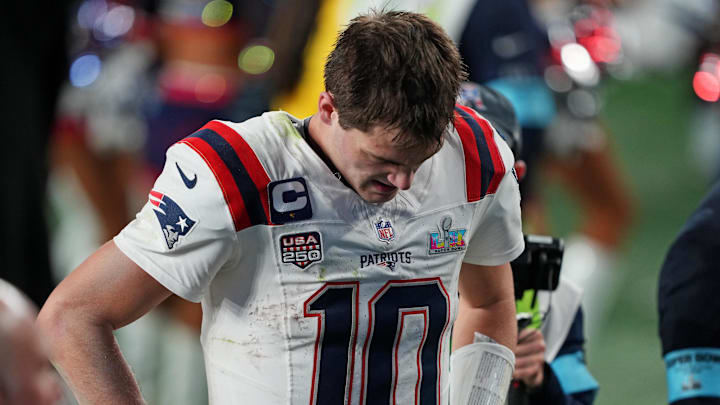
The goal for Omar Khan and Art Rooney II never changed. The Pittsburgh Steelers believe an appearance under the Super Bowl lights is not only realistic but expected. On Sunday evening, Mike Vrabel and the New England Patriots proved just how close that dream can feel — and how far away it can vanish in a matter of minutes.
The Patriots’ brutal Super Bowl LX loss to Mike Macdonald and the Seattle Seahawks should not erase what an incredible season it was. A first-year turnaround, a second-year quarterback playing at an MVP level, and a franchise reborn overnight all deserve respect. But for Mike McCarthy, watching that game wasn’t about admiration. It was about education.
And more importantly, it was about learning what not to do.
From the opening drive, it was clear New England was in trouble. Drake Maye, the league’s MVP runner-up, looked rattled and restricted in the biggest game of his young career. Seattle overwhelmed the Patriots’ offensive line, recording six sacks and a costly forced fumble.
The protection failed so thoroughly that by the time Maye could process what was happening, the game was already slipping away. Maye's struggled to connect with his receiving core, completing 2 of 43 passes for 295 yards. It was hard to watch — a talented young quarterback left defenseless on the sport’s grandest stage.
That image should stick with McCarthy.
Because the Patriots’ weaknesses looked uncomfortably familiar.
Mike McCarthy cannot ignore the Patriots' shortcomings during the Pittsburgh Steelers' 2026 rebuild
A lack of reliable skill-position depth and an offensive line still finding its identity are issues that haunted Pittsburgh all of last season. Roman Wilson remains a mystery, more projection than production. DK Metcalf, while electric, is still waiting to be paired with a true complement that forces defenses to pick their poison. The interior offensive line continues to raise questions, and Broderick Jones’ development has failed to meet the expectations attached to his draft status.
That’s the most alarming part. Jones’ absence during the second half of the season didn’t crater Pittsburgh’s offense. The Steelers didn’t thrive without him, but they didn’t collapse either. And for a team banking on a cornerstone left tackle, “holding their own” is not the standard.
The numbers tell the story. Pittsburgh finished 26th in yards per pass attempt (6.5) and 12th in quarterback sack percentage. Yes, a less mobile Aaron Rodgers didn’t make life easier. But that can’t become an excuse. The offensive line’s responsibility is universal: protect the quarterback. New England failed to do that when it mattered most, and it cost them a championship.
READ MORE: Super Bowl LX echoes lessons Steelers must learn to become a dynasty again
That’s why Super Bowl LX must become a turning point for McCarthy’s regime. Not a reminder of how close Pittsburgh is — but a warning of how fragile progress can be. Developing a young quarterback, whether it’s Will Howard or someone else, demands more than faith and patience. It demands structure. Investment. Protection.
Even if Aaron Rodgers returns.
The Patriots earned their place in the Super Bowl, no doubt. But they also became a visual sacrifice for every developing team watching closely. A reminder that no matter how talented your quarterback is, no matter how brilliant your coaching staff may be, neglecting the trenches and surrounding support will eventually catch up to you.
The Steelers cannot ignore that lesson.
If McCarthy is serious about building a contender for 2026, the foundation must be laid now. Super Bowl dreams don’t die because of talent shortages; they die because of preventable neglect. And Pittsburgh has just been shown, in painful clarity, exactly what that looks like.
 Add us as a preferred source on Google