

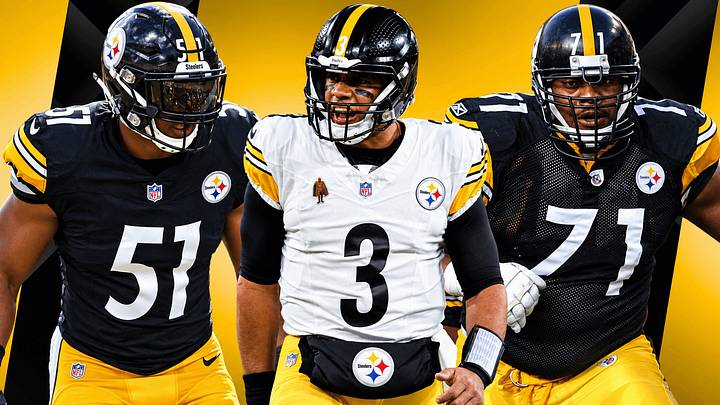
The Pittsburgh Steelers have had 25 one-year wonders worth revisiting, from a Heisman winner whose NFL career lasted one season to a cornerback who grabbed five interceptions and left. Some helped a playoff push. Others filled a hole for a few weeks or made one play that has outlived everything around it.
For this list, a player gets one Steelers regular season. The standard isn’t that every season was equally great. Flozell Adams gave Pittsburgh a starting tackle on a Super Bowl run; Eric Rowe gave an injury-ravaged secondary three badly needed starts. Those contributions belong in the same conversation for different reasons.
Still Curtain has looked at Steelers players with one standout season. This is a different roster: players whose entire on-field Steelers story fits inside one season. Their exits are part of the story, especially when Pittsburgh later needed the role they’d filled.
Johnny Lattner, RB/KR
Johnny Lattner arrived in 1954 with the Heisman Trophy and the expectations that come with being the seventh pick in the draft. He scored seven touchdowns as a rookie and made the Pro Bowl as a returner. For a franchise still searching for sustained success, that was a lot to get from one newcomer.
Then he entered the Air Force, and Lattner’s Steelers career ended after that season. His entry reminds us that an early Steelers star could disappear for reasons unrelated to a depth chart or a bad second year.
Don McCall, RB/KR
Don McCall spent 1969 with Chuck Noll’s first Steelers team, which went 1-13. Against Minnesota, he returned a kickoff 101 yards for a touchdown. Pittsburgh lost, but McCall gave that otherwise bleak afternoon a play the franchise could keep.
He also kept his place in the team record book. Pittsburgh has had far better seasons since 1969, yet a player passing through one of its worst teams still owns one of its longest returns. That’s a pretty good argument for looking beyond wins when remembering a brief stay.
Travis Davis, S
Travis Davis started all 16 games at free safety in 1999. His lasting highlight came against Carolina, when he recovered a fumble and took it 102 yards to the house. Pittsburgh won that snowy December game after six straight losses.
According to the Steelers’ account of their longest plays, Davis still owns the franchise’s longest play from scrimmage. Don McCall’s return sits one yard behind it. Neither man needed a second Steelers season to claim a record that fans can still look up.
Quincy Morgan, WR/KR
Quincy Morgan caught only nine passes for the 2005 Steelers, but two went for touchdowns. The former Browns receiver also handled kickoff returns for a team that needed production wherever it could find it on its way to Super Bowl 40.
His 71-yard return to open overtime against Jacksonville nearly sparked a winning drive; the Steelers lost instead. Morgan’s season sums up the small-role end of this list. He wasn’t a featured receiver, yet he supplied a few useful plays during a championship year.
Stefan Logan, KR
Stefan Logan gave the 2009 Steelers 1,466 kickoff-return yards and 280 more on punts. He never returned one for a touchdown, which is probably why his season gets less attention than it should. Every return still decided where an offense took the field.

The Steelers’ kickoff-return record holds his 1,466 yards. Pittsburgh released Logan before the next season, when rookie Antonio Brown joined the return options. The record-setting specialist lasted one year because the roster had other jobs to fill.
Flozell Adams, OT
Willie Colon’s Achilles injury left the 2010 Steelers needing a right tackle. Flozell Adams spent his career on the left side in Dallas, but he switched sides (sound familiar?) and started for the Pittsburgh team that reached Super Bowl 45. Asking a longtime left tackle to switch sides that late was a gamble.
Adams wasn’t there to become the next long-term fixture. He had to help keep Ben Roethlisberger upright while the team had a championship window. Pittsburgh got the season it needed from him, even though the final game ended in a loss to Green Bay.
Felix Jones, RB
The Steelers acquired Felix Jones just before the 2013 season while rookie Le’Veon Bell dealt with an injury. Jones rushed for 184 yards that year, most of them early. Once Bell was ready to take over, the shape of the backfield changed fast.
Jones makes the list because his job was to bridge an awkward opening stretch, not to challenge Bell’s eventual place in Steelers history. Pittsburgh started 0-4, so the value of his stint was keeping the backfield going until Bell returned.
LeGarrette Blount, RB
LeGarrette Blount looked like a useful partner for Bell when both cleared 100 rushing yards against Carolina in 2014. Blount finished his Steelers stay with 266 rushing yards and two touchdowns in 11 games before the team released him.

The consequence arrived when Bell hurt his knee before the playoffs. Pittsburgh entered its loss to Baltimore with Josh Harris, Ben Tate, and Dri Archer as its running-back options. We're not pretending Blount's season was a success -- his brief stint earns a place here more for the depth the Steelers lost.
Brandon Boykin, CB
The Steelers traded for Brandon Boykin before 2015, yet barely used him on defense for much of the season. When he finally got more work in the slot, he intercepted Matt Hasselbeck against Indianapolis, giving Pittsburgh another defensive playmaker in its playoff chase.
Boykin’s lone interception gave the Steelers a lift, though their secondary still had bigger problems. His stay is memorable because his late opportunity made the earlier reluctance to play him harder to understand. Steelers fans were right to wonder what a longer look might’ve produced.
Michael Vick, QB
Michael Vick’s 2015 Steelers season was mostly an exercise in getting through Ben Roethlisberger’s absence. Then came the Monday night game in San Diego. Vick hit Markus Wheaton for a 72-yard tying touchdown and helped set Pittsburgh up for Bell’s winning run on the final play.
One electric quarter didn’t erase a rocky stint as the backup, but it did deliver a road win the Steelers could use in a season that ended with a playoff berth. Vick’s contribution was brief, specific, and a lot more useful than his overall passing line might suggest.
Ladarius Green, TE
Ladarius Green appeared in only six games in 2016, catching 18 passes for 304 yards. His six-catch, 110-yard performance against the Giants showed exactly why Pittsburgh wanted his speed at tight end. For a few weeks, he gave Roethlisberger a downfield option the position hadn’t offered in quite that way.
An ankle injury delayed Green’s debut, and a concussion ended his season before the playoffs. Still Curtain’s look at Green’s Giants breakout captures the promising part of the story. The Steelers saw the fit on the field, then had to play their postseason without it.
Cobi Hamilton, WR
Cobi Hamilton caught 17 passes for 234 yards and two touchdowns in the 2016 regular season. Pittsburgh needed receiver help during its run to the AFC Championship Game, and Hamilton went from a fringe roster name to someone Roethlisberger could put on the field.
He also caught a 30-yard touchdown in the championship loss to New England. It came with the game out of reach, so it wasn't exactly a defining play, but it does show how far into the depth chart that postseason run reached.
Jon Bostic, LB
Ryan Shazier’s injury left the Steelers facing an enormous problem at inside linebacker in 2018. Jon Bostic played every game and finished with 73 tackles. He couldn’t reproduce Shazier’s range, but he gave Pittsburgh a starter while the defense worked through a difficult transition.
Bostic’s one season explains why filling a lineup spot and replacing a player aren’t the same task. His availability helped. The defense still missed the unusual things Shazier could do between the tackles and in space, and the Steelers kept searching for answers at the position afterward.
Devlin "Duck" Hodges, QB
Devlin Hodges went from undrafted rookie to starting quarterback in 2019 after Roethlisberger’s season ended and Mason Rudolph struggled. The Steelers won three of his six starts. For a few weeks, his poise and the defense’s play kept a battered team in the playoff race.
.@DevlinHodges10 is in at QB and he finds @JamesWashington for the 79-yard touchdown! #HereWeGo #PITvsCIN
— NFL (@NFL) November 24, 2019
📺: CBS
📱: NFL app // Yahoo Sports app
Watch free on mobile: https://t.co/YLI9jW8U5W pic.twitter.com/CzMLjHRDo3
Hodges also threw five touchdowns (including a 79-yard bomb to James Washington) and eight interceptions, and the offense eventually ran out of answers. Still Curtain’s coverage of Hodges' takeover recalls why fans got behind him. The affection was earned; so was the conclusion that a good emergency story hadn’t solved the quarterback problem.
Kerrith Whyte, RB/KR
The 2019 Steelers signed Kerrith Whyte off Chicago’s practice squad as injuries strained the backfield. He rushed for 122 yards on 24 carries in six games. That’s a small workload, but his burst stood out in an offense that struggled to produce easy yards.
Whyte also returned kicks, giving Pittsburgh another way to get him the ball. He wasn’t the answer to that offense’s quarterback troubles or its larger injury list, but he brought some speed to a team that badly needed it late in the season.
Mark Barron, LB
Mark Barron started nine games in 2019 and finished with 82 tackles, three sacks, and an interception. His safety background gave Pittsburgh a different kind of inside linebacker while the defense adjusted to life without Shazier.
The Steelers also drafted Devin Bush that year, so Barron’s season was always part of a wider attempt to rebuild the middle of the defense. His production was useful, if rarely spectacular. One year later, he was gone, leaving Pittsburgh with a laundry list of (non)answers at that spot.
Avery Williamson, LB
The Steelers traded the Jets for Avery Williamson in November 2020 while unbeaten and short on inside-linebacker help. Bush had been lost to injury, and the team needed an experienced player who could join the rotation quickly.
He filled in when further injuries hit, including a stretch alongside converted safety Marcus Allen. Pittsburgh’s season ended painfully after a hot 11-0 start, but the Williamson move made sense at the time. A team trying to win immediately couldn’t leave a thin position entirely to improvisation.
Joe Schobert, LB
Joe Schobert arrived by trade shortly before the 2021 season and made 112 tackles for Pittsburgh. That gave the Steelers a proven presence beside Bush, whose return from a serious knee injury made the position difficult to project.
The tackle total shows Schobert was involved; it doesn't mean the middle of the defense was fixed. Pittsburgh struggled against the run, then moved on after the season. His one-year stop shows the limit of adding a veteran to a position group whose problems extend beyond one player.
Kwon Alexander, LB
Kwon Alexander gave the 2023 Steelers an aggressive linebacker who could make a late defensive play. In a season full of narrow finishes, his fourth-down interception of Will Levis sealed a tight win over Tennessee.
Kwon Alexander. Game. #HereWeGo pic.twitter.com/4Gnj8XoZ9K
— NFL (@NFL) November 3, 2023
Alexander’s Achilles injury against Green Bay ended his season in November. Cole Holcomb missed time with an injury, leaving Pittsburgh to shuffle the middle of its defense yet again. Alexander’s brief stay is remembered for what he supplied and for how quickly the Steelers had to find replacements.
Patrick Peterson, CB/S
Patrick Peterson joined the 2023 Steelers as a veteran cornerback and finished the season doing far more than lining up outside. He had two interceptions and took on work in the slot and at safety as injuries forced changes across the secondary.
The late-career Peterson didn't ease concerns, but his willingness to move gave Pittsburgh options when Minkah Fitzpatrick and other defensive backs were out. That makes his lone Steelers season more interesting than either his reputation coming in or his interception total alone.
Markus Golden, OLB
Markus Golden had four sacks in 2023 while backing up T.J. Watt and Alex Highsmith. A reserve pass rusher can spend weeks without drawing much notice. Golden gave Pittsburgh production from that role and started the playoff game against Buffalo after Watt’s injury.
No backup would make Watt's loss disappear. Golden’s season showed why a capable third outside linebacker is useful even when the starters dominate the discussion. Pittsburgh needed him most at precisely the point its best rusher couldn’t play.
Eric Rowe, safety
Eric Rowe didn’t join Pittsburgh’s active game-day plans until late in 2023. Injuries and Damontae Kazee’s suspension pushed him into the lineup, and he started the final three regular-season games. He intercepted Jake Browning in his first appearance against Cincinnati, helping the Steelers build an early lead.
Rowe’s season is the shortest stay here that came with a genuine stretch of starting responsibility. Three games can sound like a footnote until they arrive during a playoff chase and the team has run out of healthy safeties. Pittsburgh got an experienced starter at the last possible moment.
Russell Wilson, quarterback
Russell Wilson threw for 2,482 yards, 16 touchdowns, and five interceptions in 11 regular-season games for the 2024 Steelers. After a calf injury cost him the first six starts, his return brought (slightly) more downfield passing to Arthur Smith’s offense. Pittsburgh reached the playoffs with Wilson as its starter.
But the finish changes any honest account of his season. The Steelers lost their last four regular-season games before falling to Baltimore in the Wild Card. Still Curtain’s review of that Ravens loss is part of the picture, too. Wilson improved stretches of the passing game, but his one year didn’t bring the playoff win Pittsburgh was chasing.
Justin Fields, quarterback
Justin Fields started those first six games in 2024 and went 4-2 while Wilson recovered. He threw five touchdown passes to one interception and added 289 rushing yards and five scores on the ground. His legs gave Pittsburgh a way to move the chains when the passing game stalled.
Justin Fields scores his first rushing TD with the @Steelers!
— NFL (@NFL) September 22, 2024
📺: #LACvsPIT on CBS/Paramount+
📱: https://t.co/waVpO8ZBqG pic.twitter.com/mHjDNMx55Y
Mike Tomlin went to Wilson once he was healthy, a choice that frustrates Steelers Nation to this day. Fields had protected the ball and helped win four games; the Steelers wanted more from the passing offense. The history of Steelers starting quarterbacks now includes both men for 2024, with neither becoming the team’s long-term solution.
Donte Jackson, cornerback
Donte Jackson arrived in the 2024 trade that sent Diontae Johnson to Carolina. He started opposite Joey Porter Jr. and intercepted five passes, a career high, and was key on special teams. That’s substantial production from a player asked to take a starting job immediately after a trade.
The Steelers’ review of their defensive backs credits Jackson with leading their secondary in interceptions that season. He left for the Chargers afterward. Unlike several names here, Jackson’s exit left the Steelers needing a starter opposite Joey Porter Jr. and a way to replace five interceptions. They never did.
 Add us as a preferred source on Google