

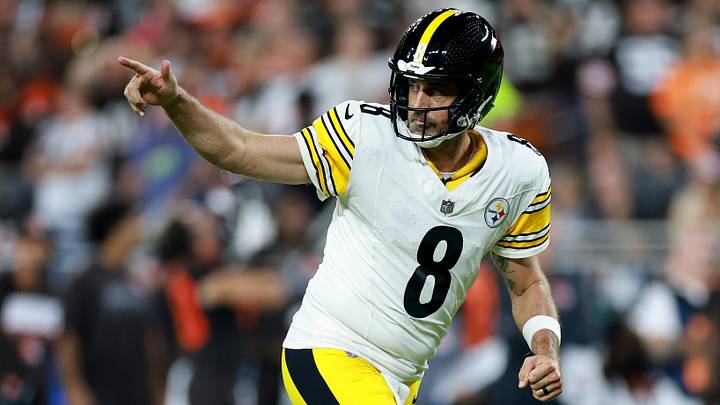
Aaron Rodgers shot down the idea that Jaylen Warren was the Pittsburgh Steelers' only option on a failed second-down pass during Thursday night's 27-24 loss to the Cleveland Browns. That's a pretty important distinction when trying to figure out what actually went wrong on one of Pittsburgh's most frustrating late-game possessions.
The sequence came with Pittsburgh trailing 24-16 late in the fourth quarter. Warren picked up five yards on first down, then Rodgers threw incomplete to him on second-and-5 from the Steelers' 37 with 5:51 left. Another incompletion to Pat Freiermuth followed on third down, and Pittsburgh punted.
From the broadcast angle, it's easy to look at that second-down throw and blame Mike McCarthy for dialing up another short pass to a running back while the Steelers desperately needed points. Rodgers' answer gives us a reason to pump the brakes on that explanation.
Pittsburgh has already shown this season that a play can have answers built into it and still fall apart once protection, routes, and quarterback timing get involved, something Still Curtain dug into in its Week 2 execution breakdown.
Aaron Rodgers' answer changes how Pittsburgh Steelers fans should judge the Jaylen Warren target
Rodgers didn't leave much wiggle room when he was asked whether Warren was the only option.
"There were five guys out in the route, so he was not the only option.”
That answer, available in Rodgers' postgame availability, tells us more than it might seem at first. Rodgers wasn't defending the play call. He wasn't saying he picked the right receiver. He wasn't blaming Warren, the offensive line, or anybody else.
He was correcting the question.
If five players were running routes, the fact that the ball ended up going toward Warren doesn't tell us what McCarthy actually designed the play to do.
That's where watching an NFL passing play from the couch can get tricky. The guy who gets the target isn't automatically the guy the play was built around. A running back underneath might be the first read. He might be the second. He might be the outlet against pressure. He might be the answer against a specific coverage. Or he might simply be the only place the quarterback can get with the pocket starting to cave in.
Aaron Rodgers spoke to the media. @Acrisure pic.twitter.com/4PNldIJZUS
— Pittsburgh Steelers (@steelers) October 2, 2026
Rodgers' answer rules out that Pittsburgh didn't call a play where Warren was literally the only receiver Rodgers could throw to. It doesn't tell us much beyond that.
The concept still could've been a bad one against Cleveland's coverage. Pittsburgh's receivers still could've failed to separate. Rodgers still could've come off another route too quickly or missed a better option. The rush still could've sped everything up enough that Warren became the only realistic throw even with four other players in the pattern.
That’s why it’s too easy to blame McCarthy based on the broadcast angle alone. Rodgers still has to answer for what he saw and why the ball went to Warren.
If all five eligible receivers released into routes, Pittsburgh wasn't keeping an extra tight end or running back home as a dedicated blocker. That puts plenty on the offensive line and the quarterback to handle the rush quickly. Rodgers didn't say whether someone chipped before releasing, whether one of the routes was delayed, or whether the protection had an adjustment built into it.
Cleveland gave Pittsburgh plenty of reasons to care about those details. The Browns sacked Rodgers five times (the most since Week 4 of 2024), with five different defenders getting home, and the Steelers spent a huge chunk of the game struggling to string drives together between their opening touchdown and the fourth-quarter comeback. Rodgers finished 22 of 40 for 299 yards, three touchdowns, and two interceptions.
That was a sharp pivot from what Pittsburgh had done four days earlier. The Steelers trimmed things down against Cincinnati, piled up 411 yards in a 30-27 win, and looked much cleaner doing it. Still Curtain broke down how Pittsburgh simplified its offense and got better results.
Cleveland dragged the Steelers right back into some of the same execution problems that had already shown up against New England.
The loss also dropped Pittsburgh to 0-10 in Thursday regular-season road games against divisional opponents in the Super Bowl era. That's a strange bit of history more than an explanation for what happened in Cleveland, but it fits the way these Thursday road trips inside the division have repeatedly gone sideways for the Steelers.
Rodgers’ explanation complicates the case against Steelers’ play calling
The Warren play is a good example of what kept going wrong for Pittsburgh. It had five players running routes on a manageable second down and still came away with an incompletion. Then the Steelers failed again on third down and gave the ball back.
So the question can't stop at, "Why did McCarthy call a pass to Warren?"
The better questions are what Rodgers saw, how Cleveland defended it, whether the protection gave him enough time to work through the concept, and whether somebody else actually gave him a better throw.
Those answers will tell us whether Pittsburgh had a play-calling problem, an execution problem, or a quarterback decision problem on that snap. Rodgers' response at least keeps us from settling for the easiest explanation just because Warren happened to be the guy at the end of the play.
 Add us as a preferred source on Google