

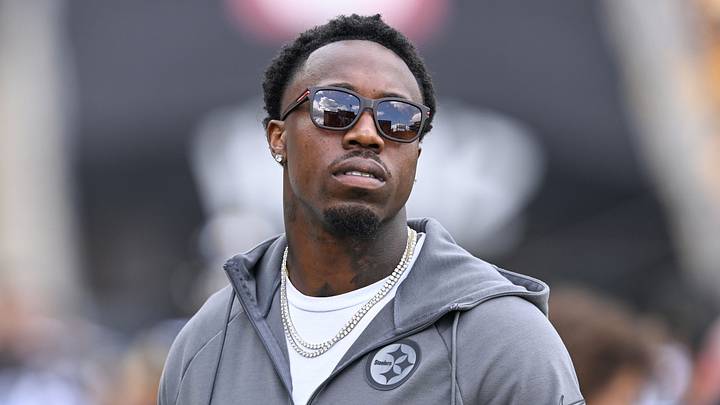
The Pittsburgh Steelers and Dallas Cowboys seem to be building a trade partnership unlike any other teams. Since May 2025, these two front offices have pulled the trigger on three trades. Their latest agreement might also be the most controversial, as the Steelers have officially sent Joey Porter Jr. to the Cowboys.
This decision by Steelers general manager Omar Khan tells us two things: the Steelers have reached the point of no return with their star cornerback, and, sadly, they aren't as serious about competing this year as the Dallas Cowboys.
The dust has barely started to settle on this deal, but fans want to know what this means for both teams. The straightforward answer is that the Cowboys are getting a CB1 who can help their defense this year, while the Steelers are getting future draft capital.
But when we look at the big picture, both sides might turn out losers in this trade.
Full Joey Porter Jr. trade details:
In exchange for fourth-year cornerback Joey Porter Jr., the Pittsburgh Steelers receive a 2027 sixth-round pick and a 2028 second-round pick. Early reports noted that the Steelers wanted to come away with second-round capital and weren't willing to budge from this.
Unfortunately for them, the Steelers won't get to use their second-round selection from the Porter trade until April 2028.
Dallas Cowboys' Joey Porter Jr. trade grade: C+
The Cowboys just added a bona fide CB1, so their fans should be rejoicing, right? Perhaps. But the luster of this shiny new toy could wear off rather quickly.
While Porter was excellent last season, he has only one great year out of three in his NFL career so far. Now he joins a zone-heavy Christian Parker defensive scheme with pass rushers who struggle to put quick pressure on the quarterback.
This is going to force Porter out of his element and make him play disciplined football late in reps. Porter, as we know, does his best work in bump-and-run man coverage and when the ball comes out quickly. There's no guarantee he looks like the same player in Dallas.
Not only that, but Porter hasn't gone full speed since January. The Cowboys are getting a cornerback who 'held in' the entire 2026 offseason and missed the first three weeks of the season. He has only logged a few full practices over the last eight months. It could take some time to knock the rust off.
But the biggest factor we need to talk about is the fact that the Cowboys were willing to trade for Porter despite not having a long-term contract extension in place. Talk about risky business. Because of this, there's nothing stopping Porter from being a one-year rental and hitting the free-agent market next March.
While the Cowboys could use the franchise tag on Porter, theoretically, they are already dealing with a similar—and equally sticky—situation with George Pickens. Dallas placed the franchise tag on Pickens in March, so he is set to become a free agent after the 2026 season. They can do the same with Porter in 2027, but even if they tag Porter, there's no guarantee they get him locked up on a long-term deal.
If the Cowboys don't get a long-term deal worked out with Porter, and if they don't find playoff success in 2026, this could end up looking like a complete flop. Let's give it a C+ for Dallas.
Pittsburgh Steelers' Joey Porter Jr. trade grade: C-
The Steelers may have gotten the raw end of this deal, but not by much. For months now, we've known that Pittsburgh would have to make one of two decisions: either overpay for their top cornerback or send him packing. The Steelers opted to dig their heels in and cut their losses.
This is a painful decision, as the organization finally drafted a truly good cornerback and wanted to keep him around for the long haul. But they didn't want it bad enough that they would be willing to pay him north of $30 million per season. Yet they had no problem trading a second-round pick for DK Metcalf last offseason and paying him $33 million per year in new money average on a rich new extension.
Make it make sense!
Two wrongs don't make a right, and the Steelers may have been worried about repeating a similar contract mistake with Porter. But even if they try to justify the trade decision this way, they still got ripped off.
Porter was in the final year of his rookie contract, but technically, the Steelers should have had as many as three total years of control. Had the two camps not come to terms on an extension, Porter could have played out the final year of his deal in 202; the Steelers could have used the franchise tag on him in 2027 (which would almost certainly be cheaper than his future per-year average), and even double-tag him in 2028.
And when this was all done, if Porter wanted to walk away, the Steelers may have been able to get third- or fourth-round compensatory capital from Porter when another team ulitmately signed him in free agency.
Instead, the Steelers opted for slightly better future draft capital but are left without their starting cornerback. That doesn't feel like a great trade-off.
I guess if there's a positive angle to take from this, it's that the Steelers were able to get three years of use out of Porter while earning a second-round pick and a sixth-round pick back. Essentially, they got their draft capital back.
Now, just like the George Pickens trade, the Steelers' Joey Porter Jr. trade results could rest on what they do with that second-round pick in 2028. But that doesn't help them win now with a 42-year-old quarterback and one of the league's oldest rosters. I'm giving this a C- for now, and we can revisit this down the road.
 Add us as a preferred source on Google