

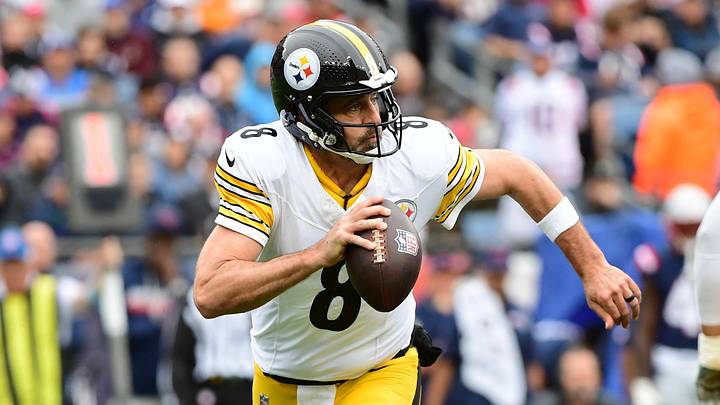
When Pittsburgh Steelers head coach Mike McCarthy met with the media for his weekly press conference on Monday, he was asked plenty of questions about his struggling offense. A 20-3 loss to the New England Patriots put the unit under the spotlight, as they managed just 235 total yards to go along with their putrid scoring output.
One of those questions was related to a comment he made about having too much "volume" in terms of the offensive game plan. When asked how he can thread the needle of being creative without putting too much on his players' plates, he admitted that he may be relying too much on his old friend at quarterback.
"I think we may have been guilty of being able to play double headers with some of the volume because of the ability of our quarterback," McCarthy said. "Aaron (Rodgers) brings a tremendous wealth of knowledge and experience, and I'm guilty of maybe relying on that too much at times."
As much as I respect the overall body of work that Aaron Rodgers has put together over 22 years in the NFL, it's clear that his offensive preferences are not producing the kind of results that this team needs.
Mike McCarthy needs to call the Pittsburgh Steelers offense how he sees fit, regardless of what Aaron Rodgers prefers
Not only did McCarthy admit to leaning on his 42-year-old QB more than he should, but he also made it clear later in his presser that the offense was designed around Rodgers' experience and strengths.
"We have a quarterback that has an incredible wealth of experience," McCarthy said. "And we built this offense based on his experience, and to play to his strengths, and he knows that, and I'm committed to it."
On the surface, there is nothing wrong with building an offense around what your QB is most comfortable with and what he is best at. It usually helps raise the floor and helps offenses get into a rhythm. The problem is that Rodgers' declining skill set means building an offense that is a very low-ceiling, pass-centric attack that often sputters if even a few things don't go their way.
Because of the boom-or-bust nature of Rodgers' playstyle, the offense needs to play essentially a perfect game from an execution standpoint if they want to move the ball consistently and put up points. He too often wants to get the ball out of his hands quickly or launch it deep, which leads to too many quick possessions and a lack of explosiveness.
According to Pro Football Focus, just 17.7% of his passing attempts ($) have gone between 10-19 yards. That is up a few percentage points from last year, but that number needs to be higher given where the talent on this offense thrives. Pat Freiermuth, Michael Pittman Jr., and rookie Germie Bernard all do their best work in that part of the field, and completions on those passes will naturally lead to more first downs and fewer difficult third-down situations.
There were signs of improvement in that area in Week 1 against the Falcons, but Rodgers' average depth of target was nearly cut in half, from 10.1 against Atlanta to 5.2 in the Patriots game. The offensive line has had its fair share of issues, but sitting in the pocket for over three seconds isn't required to attack the intermediate part of the field.
Whether his QB likes it or not, McCarthy has to start moving away from some of these bubble screens and other short passes that haven't been successful, in favor of more digs, in-breakers, and crossing routes that have some level of upside to them. If Rodgers doesn't like it, just remind him that he has been one of the least efficient passers in the NFL over the past two seasons while playing "his" way.
 Add us as a preferred source on Google