

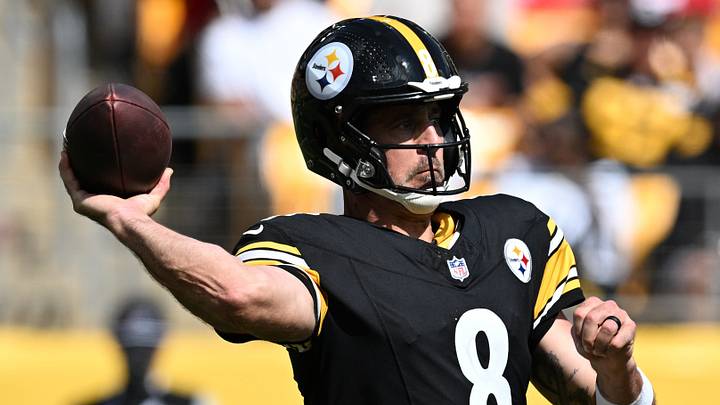
The Pittsburgh Steelers beat the Atlanta Falcons 20-13 in Week 1, but their passing attack wasted enough well-placed Aaron Rodgers throws to make the win feel like an escape and offer little proof that this offense is fixed.
Rodgers finished 24-of-40 for 221 yards, one touchdown, and no interceptions. Pittsburgh's new offense managed 264 yards, scored 13 points, converted 3-of-13 third downs, and failed on both fourth-down tries. T.J. Watt's 35-yard pick-six produced the winning points, while the offense went scoreless after halftime.
There's a hopeful way to read that. Catch two or three of the balls that hit Steelers receivers in the hands, and this offense plausibly lands in the high 20s or around 30 points. Rust explains some timing, but it doesn't excuse the high-leverage failures by the players who're supposed to make this passing game work. Rodgers wasn't the main problem.
That's reassuring for Pittsburgh's quarterback situation and not so reassuring for nearly every piece around him.
Aaron Rodgers created scoring chances, but Pittsburgh Steelers' receivers wasted them
At 42, Rodgers showed enough arm and anticipation to run Mike McCarthy's offense the way Pittsburgh hoped. He attacked downfield, layered throws between defenders, and protected the ball. An NFL.com review of the opener put his average air yards per attempt at 8.8, up from a league-low 5.9 in 2025. This didn't look like a quarterback who could no longer challenge a defense.
With 18 seconds left in the third quarter, Rodgers stood up in the pocket on third-and-3 and threaded a pass between two Falcons defenders to DK Metcalf. The ball went through Metcalf's hands, Pittsburgh punted, and a promising possession became another three-and-out. Rodgers couldn't have made it much better without walking it over and handing it to him.
Roman Wilson left an even larger play on the field late in the first half. Rodgers gave him a chance on a deep ball into the end zone; Wilson got both hands on it, and the ball came free as the Falcons defender drove him to the ground. There was enough contact for a fair pass-interference argument, and it was far from an easy catch. It was also the kind of play an NFL receiver has to finish when the ball survives the hard part and reaches his hands.
Rodgers was clearly frustrated by the lack of pass-interference calls during Wednesday's media session. "The whole thing can be deceiving," he said, then cited possible interference on several throws to Wilson and Metcalf while arguing that Pittsburgh's 3-of-13 third-down line didn't tell the full story.
Aaron Rodgers believes the Steelers offense was much better in the season opener than the stats or point production might have showed pic.twitter.com/2CRPQugThc
— Chris Adamski (@C_AdamskiTrib) September 16, 2026
Metcalf's damage extended beyond the drop. He committed two offensive pass-interference penalties, including one that erased a 19-yard gain, and caught four of his 10 targets for 40 yards. Wilson caught three of six for 26. The game's full play sequence also shows Pittsburgh taking deep shots on third-and-3 and fourth-and-3 during the same third-quarter possession, with neither attempt producing a catch.
Aggression is a warm welcome after years of cramped and conservative passing attacks. McCarthy and Rodgers still need a reliable answer when three yards, not 30, keeps the drive alive.
Rodgers also defended his top target. "I'm not worried about DK at all, man," he said, adding that he'll keep giving Metcalf opportunities. That's exactly what the quarterback should say, and abandoning Metcalf after one lousy afternoon would be foolish. Pittsburgh acquired him to tilt coverages and win the catches most receivers can't.
I Love DK Metcalf#Steelers Aaron Rodgers pic.twitter.com/Kf2w97vIyd
— 93.7 The Fan (@937theFan) September 16, 2026
The investment also removes most of the patience normally granted after a rough opener. The Steelers traded a second-round pick for Metcalf and gave him a four-year, $132 million extension. A receiver carrying that price tag can't turn 10 targets into 40 yards while losing yardage to two push-offs. Timing can improve, but catching a strike on third down and avoiding a push-off at the top of the route are basic parts of the job.
Wilson deserves more grace because his near-touchdown required a difficult finish. He also enters his third season with his role still in question. He played 37 snaps while second-round rookie Germie Bernard played three, so Pittsburgh clearly gave the veteran the first chance to own the slot job. His six targets produced too little to end the WR3 debate with Bernard. If Wilson doesn't turn those chances into production, McCarthy has another option waiting in the wings.
Michael Pittman Jr. kept this from becoming an indictment of every receiver. He caught all three of his targets for 58 yards, including a 28-yarder that started Pittsburgh's best drive of the third quarter. Pat Freiermuth scored the offense's lone touchdown and added a 19-yard catch before halftime. Rodgers found useful space in the intermediate middle of the field, and those completions gave the passing game a shape it too often lacked last season.
The group had limited preseason work together, so fluidity should come. This is Rodgers' final season, though, not a development year for an offense built around veterans. The opener showed that Rodgers’ accuracy isn't holding this offense back. Metcalf and Wilson need the extra work more than he does, and Pittsburgh can't simply assume every mistake will magically disappear once everybody logs more practice ahead of the New England Patriots.
Mike McCarthy's offense needs easier answers on third down
McCarthy owns a share of this, too. Rodgers attempted 40 passes while Jaylen Warren and Rico Dowdle combined for 18 carries, and the coach acknowledged that the Steelers can't repeat that formula. A weak run game put too much on Rodgers, but five three-and-outs and repeated failures on manageable downs weren't forced by the scoreboard. Pittsburgh led from the second quarter onward.
Week 2 at New England should tell us whether Week 1 was a sloppy first draft or the start of another season in which the defense must cover for an offense that can't finish drives. The Falcons missed two field goals and started Cooper Rush at quarterback. Pittsburgh absolutely can't count on that much help every Sunday.
The encouraging part was the ball leaving Rodgers' hand. Pittsburgh doesn't need a better version of him than it saw Sunday. It needs its pass-catchers and play-caller to stop wasting the one it already has, and for the officiating crew to get their eyes checked.
 Add us as a preferred source on Google