

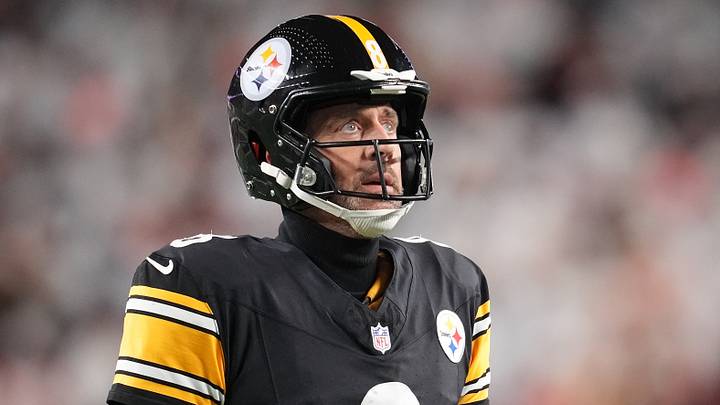
The Pittsburgh Steelers have no shortage of problems on offense. Their wide receivers struggle to gain consistent separation, while their offensive line has been up and down in pass protection this year. But nothing is more important to the team's success than the quarterback... and the Steelers should be very concerned about Aaron Rodgers.
The 42-year-old is coming off one of his worst games with the Steelers. Through the first three quarters of his Sunday Night Football performance against the Cincinnati Bengals in Week 10, Rodgers completed just seven passes for 27 yards, while his team put up just three points.
Rodgers would attempt to salvage his stats in garbage time, as he finished the game 15 of 29 for 143 yards and a pair of meaningless touchdowns. But fans need to be careful not to read too deeply into the box score numbers.
Aaron Rodgers ranks among the NFL's worst quarterbacks in most advanced metrics
When it comes to nearly every advanced QB passing stat and analytic, Rodgers ranks near the bottom of the league entering Week 11, per SumerSports and Pro Football Reference's advanced stats (minimum 100 attempts).
Aaron Rodgers' QB rankings entering Week 11:
🟥31st in EPA per play (-0.13)
🟥30th in success rate (40.34%)
🟧21st in adjusted net yards per attempt (5.3)
🟧24th in ADOT (7.55)
🟧23rd in QBR (47.8)
🟥27th in time to throw (2.61)
🟥33rd in completion % (59.94%)
🟧26th in intended air yards per pass (7.2)
🟥30th in completed air yards per comp. (4.2)
🟧26th in bad throw % (17.4%)
🟨19th in on-target throw % (72.4%)
The numbers speak for themselves, and when you put on the all-22 film, it's clear that this computes.
EPA per play is one of the best indicators of which quarterbacks are playing well and which QBs are struggling. An EPA per play of -0.13 is the same as the Titans' Cameron Ward this year and ranks below quarterbacks like Jameis Winston, Jacoby Brissett, Malik Willis, Kyler Murray, and Michael Penix.
Meanwhile, Rodgers ranks near the bottom of the league in success rate, completion percentage, and completed air yards per completion. The Steelers' quarterback also gets rid of the ball quickly, limiting the upside for big plays in Pittsburgh's offense.
Obviously, stats can be misleading at times. Rodgers can't control when his receivers are getting open or when his offensive line misses an assignment. However, he's done nothing to rise above and perform well when his players struggle.
The Pittsburgh Steelers must have serious doubts about Aaron Rodgers
You won't ever hear Mike McCarthy or his staff come out and say this, but it's hard to imagine they have much confidence left in Aaron Rodgers at this point. They've seen the offense hit rock bottom this season when Rodgers struggles.
What's wild is that Rodgers has a lower EPA per play than he did last year with Arthur Smith as his offensive coordinator. It's also lower than Russell Wilson's and Justin Fields' EPA when they were starting for the Steelers.
When you put on the tape, you see an old quarterback who struggles to avoid pressure, ditches the ball quickly, and lacks accuracy down the field. Rodgers is also unwilling to consistently hang in the pocket and deliver throws with pressure barreling down on him.
And even with a strong rushing attack this season, Rodgers can't seem to use it to set up the pass. Teams simply aren't threatened by the aging QB, so they overload boxes and dare Rodgers to beat them down the field.
At this point, it's hard to even say with confidence that Rodgers is the best QB option on his own team. And we have no business putting him in the conversation as anything more than a baseline-level starting quarterback at this stage of his career.
The Steelers brought Rodgers back for one more season despite struggling last year and having a dismal showing against the Houston Texans in the Wild Card round of the playoffs. The way he's played in recent weeks shouldn't come as a shock to anyone who watched him late last season.
 Add us as a preferred source on Google