

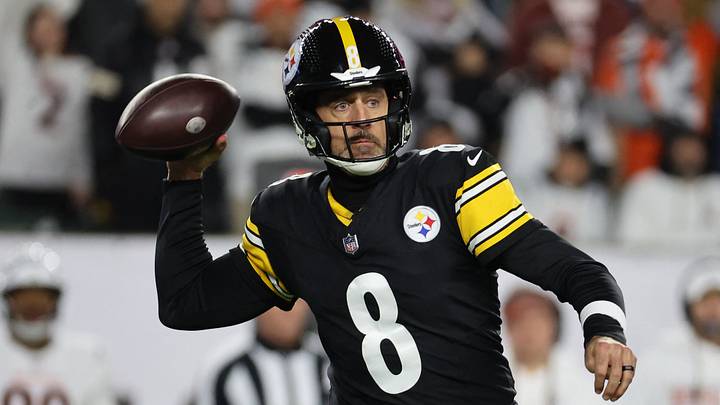
We've seen more than enough of the Pittsburgh Steelers' version of Aaron Rodgers to know what this team is getting—and how badly it falls short. The 42-year-old quarterback has struggled mightily at times this season. But that hasn't stopped many fans from being quick to run to his defense.
One point fans will use to argue that Rodgers is, in fact, having a good season is box score stats. But you'll soon understand why we should simply throw these out the window.
From basic box score stats, not only does it look like Rodgers is having a respectable season, but it also looks like he's doing more than enough to give the Steelers a fighting shot at a deep playoff run. The 22-year veteran has 2,014 passing yards, 15 touchdowns, and six interceptions through nine games.
If you prorate this over the course of a 17-game season, his stat line actually looks impressive. Entering Week 11, Rodgers is on pace for 3,804 passing yards with 28 touchdowns and 11 interceptions. Stat-wise, Rodgers would have nearly identical passing yards and five fewer touchdowns than Ben Roethlisberger had back in 2020.
But I'm here to tell you why using raw stats is a terrible way to evaluate how Rodgers has truly been playing this season.
Advanced analytics and game film tell an entirely different Aaron Rodgers tale than box score numbers
Let's start with some efficiency metrics. While you'll find plenty of football fans who scoff at advanced analytics these days, they give a much clearer picture of which quarterbacks are actually playing well compared to which QBs are simply putting up numbers.
And when you peel back the curtain, Rodgers' stat-padded season gets exposed pretty easily.
Entering Week 11, Rodgers is 31st in EPA per play (-0.13), 30th in success rate (40.34%), 21st in adjusted net yards per attempt (5.3), 24th in average depth of target (7.55), 23rd in QBR (47.8), 27th in time to throw (2.61-seconds), 33rd in completion percentage (59.94%), 26th in intended air yards per completion (4.2), and 26th in bad throw percentage (17.4%).
When you take the average of the ten advanced metrics, Rodgers is the 27th-best quarterback this season, based on the advanced data. This isn't to say that he's not a bit higher in actuality, but we can't pretend that none of this matters.
And the film aligns with the advanced metrics.
When you put on Rodgers' all-22 film, you see a quarterback who is skittish in the pocket, self-engineers pressure when he doesn't need to, and rarely targets the middle of the field. Worse yet, Rodgers simply hasn't been accurate this season. He's one of the worst deep-ball throwers in the NFL this year, and 59.94% accuracy and a 17.4% bad-throw rate show just how off the mark he's been.
The Pittsburgh Steelers' approach has inflated Rodgers' box score numbers
But advanced data and film aren't the only reasons we should ignore Rodgers' box score numbers. The Steelers' game plan and approach also play a significant role.
Take, for instance, Pittsburgh's reluctance to run the ball in the red zone.
Despite playing more than half a season—and having one of the best rushing attacks and running backs in the league with Jaylen Warren—the Steelers have just four rushing touchdowns this year. This is tied for the fewest in the NFL and is the fewest through nine games since the 2014 season, as Steelers Depot's Alex Kozora recently noted.
It's not that the Steelers can't run the football near the goal line; it's that they're hardly even trying.
Instead, the Steelers put the ball in Rodgers' hands in the red zone. Rodgers has attempted 38 passes in the red zone this year, with nine passing touchdowns coming inside of 20 yards, per Pro Football Reference. In comparison, Texans' QB C.J. Stroud has 16 touchdowns in the red zone on fewer attempts (37). Moreover, seven of Rodgers' nine red zone touchdowns have come from inside 10 yards.
Instead of wisely running the football with Warren to reach paydirt, Rodgers has been inflating his numbers with passing scores when the Steelers get close to the endzone.
But that's not the only way he's inflating his production.
While the Steelers have been competitive in most games this season, we just witnessed the most despicable display of stat-padding when the game was well out of reach. On Sunday Night Football against the Bengals in Week 10, Rodgers completed just seven of 19 passes through the first three quarters for a mere 27 yards.
With Pittsburgh down 31-3 entering the fourth, the wise decision would have been for McCarthy to bench Rodgers (and the most important Steelers starters). Instead, in meaningless, garbage-time action with the game well out of reach, Rodgers recorded 116 passing yards and a pair of touchdown passes.
If the Steelers had pulled Rodgers from the game or if they'd simply run the football in the red zone more (as they should), the 42-year-old would not have the raw numbers that he does.
Now combine all of this together: What does the film, data, and game plan suggest?
Rodgers has an average rank of 27th across 10 advanced passing metrics; the film highlights significant struggles on a play-by-play basis, the Steelers are too pass-happy in the red zone (which inflates Rodgers' numbers), and they don't pull him from games when they should.
Take Aaron Rodgers' box score stats, crumple them up, and throw them out with the trash. They are incredibly misleading.
 Add us as a preferred source on Google